Jul 11, 2011

16th July 2011; Documentaries on Art : ANDY WARHOL


CONTEMPLATE & K
ONANGAL

present


Documentaries on Art
Contemplate Art Gallery
Opp. PSG Krishnammal College
Avanashi Road

16th July 2011 ; 5.45pm


Pop art

Pop art is an art movement that emerged in the mid 1950s in Britain and in the late 1950s in the United States. Pop art challenged tradition by asserting that an artist's use of the mass-produced visual commodities of popular culture is contiguous with the perspective of fine art. Pop removes the material from its context and isolates the object, or combines it with other objects, for contemplation. The concept of pop art refers not as much to the art itself as to the attitudes that led to it. Pop art employs aspects of mass culture, such as advertising, comic books and mundane cultural objects. It is widely interpreted as a reaction to the then-dominant ideas of abstract expressionism, as well as an expansion upon them.And due to its utilization of found objects and images it is similar to Dada. Pop art is also associated with the artists' use of mechanical means of reproduction or rendering techniques.

Andy Warhol

Andy Warhol was born Andrew Warhola August 6, 1928. Born to Slovak immigrants, he was reared in a working class suburb of Pittsburgh. From an early age, Warhol showed an interest in photography and drawing, attending free classes at Carnegie InstituteProphetically, his first assignment was for Glamour magazine for an article titled "Success is a Job in New York."
Throughout the nineteen fifties, Warhol enjoyed a successful career as a commercial artist, winning several commendations from the Art Director's Club and the American Institute of Graphic Arts. During this period, he shortened his name to "Warhol." In 1952, the artist had his first solo exhibition at the Hugo Gallery, exhibiting Fifteen Drawings Based on the Writings of Truman Capote. Subsequently, Warhol's work was exhibited in several venues throughout the fifties including his first group show at The Museum of Modern Art in 1955. In 1953 the artist produced his first illustrated book, A is an Alphabet and Love is a Pink Cake, which he gave to his clients and associates. With a burgeoning career as an illustrator, he formed Andy Warhol Enterprises in 1957.1960 marked a turning point in Warhol's prolific career. He painted his first works based on comics and advertisements, enlarging and transferring the source images onto his canvases with an opaque projector. In 1961, Warhol showed his paintings, Advertisement, Little King, Superman, Before and After, and Superman, Before and After, and Saturday's Popeye in a window display of Bonwit Teller department store. Appropriating images from popular culture, Warhol created many paintings that remain icons of 20th-century art including the Campbell's Soup Can, Marilyn and Elvis series. In 1962, the Ferus Gallery in Los Angeles exhibited his Campbell's Soup Cans and in New York, the Stable gallery showed the Baseball, Coca-Cola, Do It Yourself and Dance Diagram paintings among others. In 1963 Warhol established a studio at 231 East 47th Street which became known as the "Factory."


In addition to painting and creating box sculptures such as Brillo Box and Heinz Box, Warhol began working in other mediums including record producing (The Velvet Underground), magazine publishing (Interview) and filmmaking. His avant-garde films such as Chelsea Girls, Blow Job and Empire have become classics of the underground genre. In 1968, Valerie Solanis, a periodic factory visitor, and sole member of SCUM (Society for Cutting Up Men) walked into the Factory and shot Warhol. The attack was near fatal.

In the 1970's, Warhol renewed his focus on painting and worked extensively on a commissioned basis both for corporations and for individuals whose portrait he painted. Works created in this decade include Skulls, Hammer and Sickles, Torsos, Maos and Shadows. Warhol also published The Philosophy of Andy Warhol (from A to B and Back Again). Firmly established as a major 20th-century artist and international celebrity, Warhol was given a major retrospective of his work at the Pasadena Art Museum which traveled to museums around the world. In the late seventies Warhol began dictating an oral diary to his colleague Pat Hackett, which became the basis for the best-selling Andy Warhol Diaries. He also frequented Studio 54 along with other members of the international jet-set saying, "I have a social disease. I have to go out every night."

The artist began the 1980's with the publication of POPism: The Warhol '60s. He also began work on Andy Warhol's TV, a series of half hour of video programs patterned after Interview magazine. In 1985, "Andy Warhol's Fifteen Minutes" appeared on MTV, half hour programs featuring celebrities, artists, musicians, and designers, with Warhol as the host. The paintings he created during this time included Dollar Signs, Guns and Last Suppers. He also produced several paintings in collaboration with other artists including Keith Haring, Jean-Michel Basquiat and Francesco Clemente.

Following routine gall bladder surgery, Andy Warhol died of complications during his recovery on February 2, 1987. (Compiled from Internet sources)


Jul 4, 2011

10th July 2011; Masaki Kobayashi's HARAKIRI


HARAKIRI

A film by Masaki Kobayashi
Country:Japan
Year: 1962
Japanese with English subtitles
Runtime: 133 mins
10th july 2011;5.45pm
Perks Mini Theater

Japanese director Masaki Kobayashi came of age in the postwar moment, a time when filmmakers were at the vanguard of dissident expression in that country. Drawing upon a rich history of protest in Japanese cinema, which had fallen dormant during the war and occupation years, filmmakers seized the opportunity to challenge those institutions that remained wedded to the nation’s feudal past. Of this generation of directors, none was as passionate as Kobayashi.
A samurai was a warrior employed by a daimyo. There were five classes of samurai, ranging from average foot soldier to high administrative personal, and while privileges varied, they all lived by the samurai code, which basically was to follow giri (duty to the lord) and bushido (way of the warrior). This meant, that the life of the samurai was in the hands of the daimyo. To give ones life to serve was the only way to die for a samurai.
Kobayashi's Harakiri is a scathing denouncement of feudal authority and hypocrisy. Based on a novel by Yasuhiko Takiguchi, Harakiri is a scathing indictment on the hypocrisy, repression, and barbarism of codified behavior. Using rigid rectangular framing against fluid tracking shots and exquisitely composed long shots that delineate class station and social disparity, Masaki Kobayashi visually reflects the oppressive confinement and regimentation of the samurai bushido (code of conduct): the title sequence presented against shots of the empty passageways that lead to the sacred chamber of the Iyi clan's ancestral armor; the isolating, diagonal shots of Saito's interviews with Tsugumo and Chijiwa; the repeated image of Tsugumo on a ceremonial mat encircled by retainers. The visual style of Kobayashi is stunning. A master of long focal compositions, his mise-en-scene are carefully arranged in terms of space and layers. Note the use of present lines and shadow to divide the frame into layers, each with its own importance.
Equally impressive are his fight sequences, where he alters extreme long shots with close up. “Hara Kiri” hints towards Kobayashi’s flirtation with avant garde techniques, but only hints by the use of a sudden zoom or pan.

By illustrating the class stratification and imposed social conformity fostered by the Tokugawa shogunate (1600-1867) as a means of retaining and centralizing authority, Kobayashi presents a harrowing indictment of the ingrained cultural legacy of coercive, outmoded rituals, chauvinism, and blind obedience that resulted in the inhumanity and senseless tragedy of the Pacific War.


Masaki Kobayashi

Masaki Kobayashi is one of Japan's most outstanding post-war humanist filmmakers. A contemporary of Akira Kurosawa and Kon Ichikawa, Kobayashi's personal experience of the Second World War has marked his pictures with a deep concern for social justice. This is well illustrated by two of his most well known films, the epic WW II trilogy The Human Condition (Ningen no Joken, 1959-61) and the period drama Harakiri (Seppuku, 1962). The anti-feudal critique expressed in Harakiri is reiterated in Kobayashi's 1967 samurai film Rebellion (Joiuchi).
His most acclaimed films are unflinching explorations into the dark side of Japanese culture, the side that drove men to commit gory suicide for the name of honor and commit horrific atrocities in the name of the Emperor. Kobayashi's exacting professionalism makes his films a visually and emotionally power experience.

Born in February, 1916, in Japan's northern-most island Hokkaido, Kobayashi entered prestigious Waseda University in 1933 . Kobayashi eventually left Waseda to enter Shochiku's Ofuna studios. Kobayashi worked as an assistant for a mere eight months before he was drafted and sent to the front in Manchuria. Opposed to the war, which he viewed as senseless, he refused to rise above the position of private. In 1944, he was transferred to the southern Ryukyu Islands, where he witnessed the war's final bloody tumult. There he was captured by the U.S. and held for a year in a detention camp in Okinawa.

In the fall of 1946, Kobayashi returned to Shochiku and served for six years as an assistant director under Keisuke Kinoshita. He garnered international acclaim and a prestigious San Giorgio prize at the Venice Film Festival in 1960 for his Human Condition I: No Greater Love (1958), the first installment of sweeping trilogy about the war. Kobayashi's films brought to life by the masterful performances of Nakadai in such Kobayashi classics as Harakiri (1962), Kwaidan (1964), and Samurai Rebellion (1967).With the acclaimed Kwaidan, his first color film, he pushed this emphasis on composition with his expressionistic use of color. Kobayashi died in of a heart attack in 1996.
(Source:Internet)

Jun 27, 2011

3rd July 2011; PEEPLI LIVE


Peepli Live
A film by Anusha Rizvi
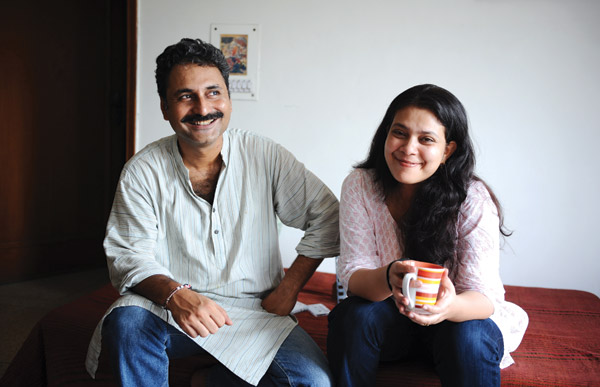
Mehmood Farooqi : Co director
Year:2010
Runtime :
With English subtitles
3rd July 2011 ; 5.45pm
Perks Mini Theater

A television crew intrudes into a village hutment and plonks a camera bang in the middle of its cramped, messy space. It is looking for an exclusive, TRP-boosting ‘conversation’ with a suicidal farmer. The latter, dread and bewilderment writ large on his face, cringes in a corner of the room. The star reporter, doing her best to exude sympathy, seeks to assuage the man's fears. "Don’t be afraid," she says. "This camera cannot do anything."
Well, the TV cameras do an awful lot of things in Peepli Live, and not all of it is of a salutary nature. Writer-director Anusha Rizvi's debut feature, a disarmingly simple but remarkably powerful film, is a major triumph. She taps into the power of the medium to narrate a story rooted firmly in the depressing realities of rural India, but without ever going into paroxysms of self-righteous indignation.

Peepli Live lampoons an entire range of usual suspects – voyeuristic media persons, smarmy bureaucrats, scheming local-level political goons and self-serving rulers, all of whom want a piece of the sleepy village where a farmer is about to kill himself so that his family can survive. Thanks to the film's nifty blend of humour and bathos, it does not slip into diatribe mode. It instead acquires the spiky edge of a pulsating yet biting satire.
Rizvi collates elements from the theatre of the absurd to craft her sly portrait of a grim scenario that urban Indian moviegoers are rarely, if ever, exposed to. The film explores the clinical and incongruous response of the media and the ruling establishment to what is a life and death question for a farmer on the brink of becoming just another statistic in a never-ending tale of woes. This coldness is best captured in the nonchalant refrain of the natty agriculture secretary: "we must wait for the court's order."
The peasant-protagonist Natha (amateur actor Omkar Das) cannot wait. He and his elder brother, Budhia (Raghuvir Yadav), are in danger of losing their plot of land, having failed to repay a bank loan. By way of one last desperate throw of the dice, Natha decides to commit suicide in the hope of securing a government compensation of Rs 100,000 for his dependents. But as word gets around, the media descends on the village for a scoop and opportunistic politicians jump into the fray to draw mileage from Natha's predicament.
As the frenzy peaks, cold drink kiosks and tea stalls come up around Natha's house in next to no time. The whole world wants to know whether Natha will really die. But does anybody really care?
We laugh as everybody in Peepli seems to cut a sorry figure. But do we feel guilty as well? Peepli Live seeks to push us across the line that divides detached glee and genuine concern.
A film that ends by informing the audience that "8 million farmers quit agriculture in India between 1991 and 2001" and does so with the muscular backing of Bollywood superstar Aamir Khan and UTV Motion Pictures, one of the biggest production houses of the Mumbai movie industry, is nothing short of a miracle.
Source: review by Saibal Chatterjee (NDTV)
http://movies.ndtv.com/movie_review.aspx?id=539
(Saibal Chatterjee is a National Award-winning film critic who has covered film festivals around the world, including the ones in Cannes and Toronto. He writes reviews for NDTVMovies.com)


Anusha Rizvi & Mehmood Farooqi


Peepli lIve was conceived and made by Anusha Rizvi and her husband Mehmood Farooqi.Mehmood Farooqui remembers how Anusha Rizvi came out of their bedroom five years ago and announced, “I have an idea.” She had been jotting possible film ideas in a register for a while and this receptivity paid off when she saw a TV programme about farmer suicides. She was intrigued, she says, how the compensation is decided only after the death, “so what becomes important is the dead body, not the living person.” While she knew the entire story and its tone in that one flash, and knew she wanted Raghubir Yadav to play Budhia, it took her a year to write it and begin pitching. Amir Khan confirmed his interest in 2006 and the contract was signed in 2009.Rizvi studied at Sardar Patel Vidyalaya and St Stephen’s, Delhi while Farooqui attended The Doon School, St Stephen’s, Oxford and Cambridge. After NDTV, the duo shifted to Mumbai to crack the film industry. Rizvi returned after a year, and he followed a few years later to escape Bollywood’s boredom. Both freelanced: Rizvi did documentary work while Farooqui toiled on Urdu translations, a MiD DAY column and reviving the storytelling art of dastangoi.

Now back in their Delhi base, Rizvi has no new projects planned while Farooqui prepares to release his first book — on the 1857 uprising in Delhi.
(Source http://www.tehelka.com/ )

Jun 14, 2011

19th June 2011; Andre Wajda's ASHES AND DIAMONDS

Ashes and Diamonds
A film by Andre Wazda
Country:Poland
Year: 1958
Runtime: 103 minutes
Polish with English subtitles
19th June 2011; 5.45pm
Perks Mini Theater, Perks School

Exclusive 30 minutes documentary :
Andrzej Wajda: On Ashes and Diamonds


Andrzej Wajda’s third full-length film, Ashes and Diamonds (Popiol y diament) established the director as a leader of the new Polish cinema. Set in a provincial town on May 8, 1945, the day of the German capitulation, Ashes and Diamonds deals ostensibly with the emergence of a Russian-backed Communist regime threatened by armed adversaries.
Previously the Nazis were the common enemy. Now the two groups who led the anti-German struggle—the London-directed Home Army and the pro-Moscow People’s Army—are on opposite sides of the ideological divide. Because the Red Army liberated Poland, the pro-Soviet faction (headed by Poles returning from the USSR) has gained control. A state of civil war exists as splinter groups of Home Army irregulars take to the forests. Members of such a band, Andrzej and Maciek have been conditioned to feel that they owe unquestioning military allegiance to their commanders.
Based on Jerzy Andrzejewski’s 1948 novel of the same name, Ashes and Diamonds was adapted for the screen by Wajda and the author. Time and space have been condensed to less than twenty-four hours in and around a single location—the hotel Monopol—giving the drama great theatrical intensity. Maciek, representative of Poland’s “lost” war generation, is the tragic hero, compelled to commit a crime by the fatality of history. Bound by the soldier’s code of honor to a past steeped in blood, he kills on order without doubts or remorse.
During long years of dismemberment and foreign occupation, literature and drama in Poland had always kept alive belief in the nation’s revival. In Ashes and Diamonds, Wajda continues this tradition, posing the question of Poland’s postwar identity. The thoughtful, tired, middle-aged revolutionary Szczuka adheres to the communist line about building a collectivist future. But he lacks the energy and resources to accomplish his own goals.
The terrorist Maciek has no answer but violence. Yet the handsome young rebel, overflowing with vitality, moves passionately among national mythic images of suffering and heroism: the white horse, the inverted crucified Christ, the poetry in the ruined church.Ashes and Diamonds has rightly been lauded as one of the finest of postwar East-Central European films, and the most vital work of the Polish School.
(Source:Internet)


Andrzej Wajda

Andrzej Wajda (born March 6, 1926 in Suwałki) is a Polish film director He is one of the most prominent members of the Polish Film School. A major figure of world and Eastern European cinema after World War II, Wajda has made his reputation as a sensitive and uncompromising chronicler of his country's political and social evolution. The son of a Polish cavalry officer who was killed by the Soviets in 1940, Wajda fought in the Home Army against the Germans when he was still a teenager. After the war, he studied to be a painter at Kraków's Academy of Fine Arts before entering the Łódź Film School.

On the heels of his apprenticeship to director Aleksander Ford, Wajda was given the opportunity to direct his own film. With A Generation (1955), the first-time director poured out his disillusionment over jingoism, using as his alter ego a young, James Dean-style antihero played by Zbigniew Cybulski.Wajda went on to make two more increasingly accomplished films, which further developed the antiwar theme of A Generation: Kanal (1956) and Ashes and Diamonds (1958), also starring Cybulski.

Wajda was more interested in works of allegory and symbolism, and certain symbols (such as setting fire to a glass of liquor, representing the flame of youthful idealism that was extinguished by the war) recur often in his films Wajda's later devotion to Poland's burgeoning Solidarity movement was manifested in Man of Marble (1976) and Man of Iron (1981), with Solidarity leader Lech Wałęsa appearing as himself in the latter film. The director's involvement in this movement would prompt the Polish government to force Wajda's production company out of business. In 1983 he directed Danton , a film set in 1794 (Year Two) dealing with the Post-Revolutionary Terror. The film carries sharp parallels with the Post-Revolutionary period in Russia as well as with fascist Germany.

At the 2000 Academy Awards, Wajda was presented with an honorary Oscar for his numerous contributions to cinema; he subsequently donated the award to Kraków's Jagiellonian University. In February 2006, Wajda received an honorary Golden Bear for lifetime achievement at the Berlin International Film Festival. Wajda , well past his 80th year, is still making films .

Jun 6, 2011

12th June 2011; Melville's RED CIRCLE

The Red Circle
A film by Jean-Pierre Melville
Year: 1970
Country: France
Run time: 140 minutes
12th June 2011; 5.45pm
Perks Mini Theater, PERKS school.

Gliding almost without speech down the dawn streets of a wet Paris winter, these men in trench coats and fedoras perform a ballet of crime, hoping to win and fearing to die. Some are cops and some are robbers. To smoke for them is as natural as breathing. They use guns, lies, clout, greed and nerve with the skill of a magician who no longer even thinks about the cards. They share a code of honor which is not about what side of the law they are on, but about how a man must behave to win the respect of those few others who understand the code.

Jean-Pierre Melville watches them with the eye of a concerned god, in his 1970 film "Le Cercle Rouge." His movie involves an escaped prisoner, a diamond heist, a police manhunt and mob vengeance, but it treats these elements as the magician treats his cards; the cards are insignificant, except as the medium through which he demonstrates his skills.

"The Red Circle," refers to a saying of the Buddha that men who are destined to meet will eventually meet, no matter what. Melville made up this saying, but no matter; his characters operate according to theories of behavior, so that a government minister believes all men, without exception, are bad. And a crooked nightclub owner refuses to be a police informer because it is simply not in his nature to inform.

The movie stars two of the top French stars of the time, Alain Delon and Yves Montand, as well as Gian Maria Volonte. All of the actors seem directed to be cool and dispassionate, to guard their feelings, to keep their words to themselves, to realize that among men of experience almost everything can go without saying. There is one cool, understated scene after another. The heist itself is performed with the exactness we expect of a movie heist. We are a little startled to realize it is not the point of the film. In most heist movies, the screenplay cannot think beyond the heist, is satisfied merely to deliver it. "Le Cercle Rouge" assumes that the crooks will be skillful at the heist, because they are good workmen. The movie is not about their jobs but about their natures.
Melville's own professionalism -- his understanding of action filmmaking as a kind of lyric poetry -- gives ''Le Cercle Rouge'' its cool, muted impact. It is a long, at times mind-twistingly intricate movie, but there is never a rushed shot, a perfunctory cut or a wasted movement. There are, instead, moments of breathtaking strangeness and blunt emotional force: cold-blooded shootings, creepy-crawly alcoholic hallucinations, spangly dancers and nighttime streets. These things could exist -- could look like this, or seem to mean anything -- only in movies. ''Le Cercle Rouge'' offers the kind of experience that makes you glad movies exist.
(Source: Internet / rogerebert.com )


Jean-Pierre Melville

Poet of the underworld

Film-maker Jean-Pierre Melville's life was a running battle with critics and fans alike. But the 'garlic gangster' won in the end.

Born in Paris, France, Melville, who was an Alsatian Jew, served in World War II and fought in Operation Dragoon. When he returned from the war he applied for a license to become an assistant director, but was refused. Without this support, he decided to direct his films by his own means.

He became an independent film-maker, owning his own studios, and became well known for his tragic, minimalist film noirs, such as Le Samouraï (1967) and Le Cercle rouge (1969), starring major, charismatic actors like Alain Delon (probably the definitive 'Melvillian' actor), Jean-Paul Belmondo and Lino Ventura. His directorial style was influenced by American cinema and fetishized accessories like weapons, clothes and especially hats.

His independence and his 'reporting' style of film-making (he was one of the first French directors to use real locations regularly) were a major influence on the French New Wave film movement, and he appears as a minor character in Jean-Luc Godard's seminal New Wave film Breathless. When Godard was having difficultly editing Breathless, it was Melville that suggested that he just cut directly to the best parts of a shot. Thus, the films famous and innovative use of jump cuts were made.

In 1973, Jean-Pierre Melville died. In a career spanning 25 years, the director had made just 13 full length films, but many of these are regarded as genuine triumphs of French cinema.