Art Documentary screening at
Contemplate Art Gallery
on 30th October 2010


 The first featured artist in the “Place” hour is Richard Serra. The segment follows Serra as he guides the viewer through several massive installations he has done in New York, San Francisco, and Bilbao, Spain. Having worked with metal for the past forty years, Serra creates sculptures shape and stretch steel like rubber, carving intimate moments out of public spaces. "I was surprised that people who had absolutely no information about sculpture were able to enter into these pieces," says the artist. "The experience for them was fulfilling because, in some sense, it was startling, it was new, because they couldn't locate themselves."
 The documentary shifts to Lexington, Virginia where Sally Mann is working in her studio on a new series of "dog bone" photographs. “What I like about these dog bones is their ambiguity. I mean, I love that aspect of photography, the mendacity of photography. It’s got to have some kind of peculiarity in it or it’s not interesting to me.” The work-ethic of Sally Mann, whose intricate photographic techniques record the historical scars and romanticism of the South, is as she takes photos both in her studio and outdoors. The farm where Mann lives and works becomes a meaningful backdrop as her inspired process of capturing it on film is revealed.


 Rembrandt ( July 15, 1606 – October 4, 1669) was a Dutch painter and etcher. He is one of the greatest painters and print makers in European art history and the most important in Dutch history. His contributions to art came in a period that historians call the Dutch Golden Age.
 Konangal had already screened on 18th May 2009, two one hour documentaries – one on Rembrandt by Simon Schama and one on Rembrandt’s masterpiece Night Watch.
 We will be showing chapters looking at Rembrandt's work and his painting and etchnique techniques. This is the best part of this documentary . It's a slideshow of his work, showing examples you've seen and others you're unlikely to have seen.

 Departures
 Departures" is a gentle film about a quiet man in conflict with his world, his father, himself. It is also about death and its rituals. Yet the film manages to be anything but dark; whimsy and sweet irony are laced throughout, a warmhearted blend.
 Daigo, it's central character, is a cello player of great dedication but middling talent, a member of a Tokyo orchestra playing to half-filled houses while he dreams big classical dreams. The demons inside Daigo (Masahiro Motoki) are quiet too. They don't so much rage as roughhouse around inside of him.
 When the orchestra falls on hard times and Daigo finds himself out of a job, his dreams are the first thing to go. Then the beloved cello, soon after the apartment in the city. Stripped of everything, including his dignity, he finally begins the journey back home with his wife, Mika.
 There are powerful themes in "Departures," of failure and lost fathers, but Japanese director Yojiro Takita and screenwriter Kundo Koyama handle them gently too, creating a Minimalist painting of a film that uses the sweeping solitude of the countryside, the steamy intimacy of the public baths and the close quarters of Daigo's home to give us a measure of his moods. Takita is blessed with actors who move lightly, gracefully within this landscape.
 Based on the novel Coffinman by Shinmon Aoki, the film offers a moving rumination on the link between the living and the dead along with a fascinating portrait of life in rural Japan and traditions gradually being discarded by the young. It’s also funny as hell in places.
 In this film, Kore-eda's "After Life" and of course Kurosawa's great "Ikiru," the Japanese reveal a deep and unsensational acceptance of death. It is not a time for weeping and the gnashing of teeth. It is an observation that a life has been left for the contemplation of the survivors.


 Billy Wilder's "Sunset Boulevard'' is the portrait of a forgotten silent star, living in exile in her grotesque mansion, screening her old films, dreaming of a comeback. But it's also a love story, and the love keeps it from becoming simply a waxworks or a freak show.
 Gloria Swanson gives her greatest performance as the silent star Norma Desmond, with her grasping talons, her theatrical mannerisms, her grandiose delusions. William Holden tactfully inhabits the tricky role of the writer half her age, who allows himself to be kept by her. But the performance that holds the film together, that gives it emotional resonance and makes it real in spite of its gothic flamboyance, is by Erich von Stroheim, as Norma's faithful butler Max.
 The movie cuts close to the bone, drawing so directly from life that many of the silent stars at the movie's premiere recognized personal details. In no character, not even Norma, does it cut closer than with Max von Mayerling, a once-great silent director, now reduced to working as the butler of the woman he once directed--and was married to. There are unmistakable parallels with von Stroheim, who directed Swanson in "Queen Kelly'' (1928).
 In one of the greatest of all film performances, Swanson's Norma Desmond skates close to the edge of parody; Swanson takes enormous chances with theatrical sneers and swoops and posturings, holding Norma at the edge of madness for most of the picture, before letting her slip over.
 We might not take her seriously. That's where Max comes in. Because he believes, because he has devoted his life to her shrine, we believe. His love convinces us there must be something worth loving in Norma, and that in turn helps explain how Joe can accept her.
 Sunset Blvd. is considered by some to be a black satire, by others to be film noir, and by others as a character-centered drama. To an extent, all of these categorizations are correct, since elements of the three are present in the text. What everyone can agree upon, however, is that this is the greatest film about Hollywood ever put on celluloid by Hollywood.

 Billy Wilder

 The Ascent
 Survival and sacrifice are at the forefront of Larisa Shepitko’s World War II drama “The Ascent” – only fitting since the film, at once simple, at the next complex, is ultimately an allegorical portrait of Christ and Judas in a world turned topsy-turvy by the senseless strife and slaughter during the German invasion and occupation of Belarus.
 For the Ukrainian-born Shepitko, herself a student of Master Ukrainian filmmaker Olexander Dovzhenko, it is clear why this story resonated with her and why she applied such staggering Dovzhenkian compositions to the picture. Coming from Ukraine, a country and culture that had been under the yoke of occupation and suppression almost from its very beginnings.
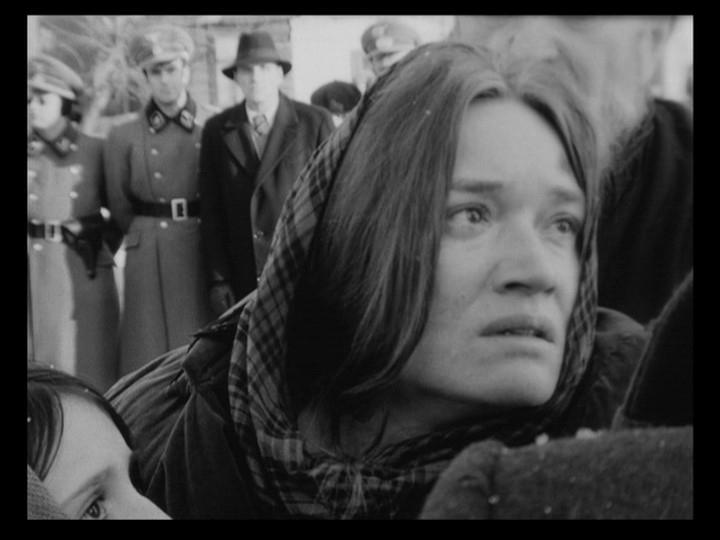 The story is a simple one. It is also both tragic and compelling. Ultimately, however, it is the simple narrative backbone that allows Shepitko to inspire an audience’s engagement in the proceedings as well as opportunities for contemplation and reflection both during and after seeing the film.
 The Ascent follows the path of two peasant soldiers, cut off from their troop, who trudge through the snowy backwoods of Belarus seeking refuge among villagers. Their harrowing trek leads them on a journey of betrayal, heroism, and ultimate transcendence.
 Shepitko’s emotionally overwhelming final film won the Golden Bear at the 1977 Berlin Film Festival and has been hailed around the world as the finest Soviet film of its decade. Set during World War II's darkest days .

 Larisa Shepitko
 The Children Are
 The child knows. Although just a diminutive four-year-old, utterly naive about the world around him, he senses--he knows--that something is not right with his parents.
 Vittorio De Sica’s The Children Are Watching Us (I bambini ci guardano), a precursor to Italian neorealism that relates the heart-breaking account of a family’s dissolution and the destructive effect it has on the child perpetually caught in the middle.
 Telling the story almost entirely from the point of view of the child (note how low the camera always is), De Sica exposes how the failings, hypocrisies, and selfishness of parents can render them not only useless in protecting and guiding their children, but actively hurtful.The child in question is Pricò, who is played with absolute conviction and tenderness by Luciano De Ambrosis.
 There's always a sense of harsh movement in the film, lines of action isolating objects and characters into different stratums of the frame. A geometric, spider-like pattern emerges throughout, with little Pico caught in the center, gasping for breath like an ensnared animal, threatened from either side by all sorts of twin pressures.
 No one feels this pressure more than Pico. In the film's single greatest scene, father and son lock eyes like hunter and prey, one asking the other for the information he already knows, the other resisting because he knows submission will completely devastate the family.
 There is an elevator in the film that only goes up, a symbol of Andrea's lack of foresight. Similarly, De Sica's camera often travels forcefully in one direction away from his characters. During a wonderfully hypnotic beach scene, an effete gentleman with a little dog tries to seduce Nina with his eyes and the movement of the camera suggests the woman is being torn apart like a piece of taffy—on one side by her pleasure-seekingness, on the other by her dedication to her son, whom she holds in her hands trying to teach how to swim.
 It is in the final scene that The Children Are Watching Us builds to its powerfully emotional climax. It is a heart-rending moment in which you feel a human connection being literally ripped away, making the film one of a handful that treats the difficulties of childhood with such a deft, tender hand as to avoid all sense of cloying sentimentality.
 The Children Are Watching Us is a marvel of complex visual and emotional scope -this is the first neorealist gesture, a sign that the Italian film was about to grow up.


