Mar 18, 2014

23rd March 2014; A River Called Titas by Ritwik Ghatak


A River Called Titas
A film by Ritwik Ghatak


Bangladesh/ 1973/ 158 minutes, in Bengali with English subtitles, black and white.
Based on a novel by by Advaita Malla Burman.
Restored in 2010 by the World Cinema Foundation and Cineteca di Bologna.

Screening on 23rd March ; 5.45pm
Perks Mini Theater


Ritwik Ghatak adapts Advaita Malla Barman sweeping novel detailing the downfall of a once-thriving fishing village situated along the River Titas. The tale is set among the Malo fishermen who toil on the waters of the Titas. The community includes both Hindu and Muslim families, though Hindu characters dominate the narrative. The central figures are Basanti, a young girl: Kishore, a fisherman: Rajar Khi, Kishore’s bride; and Ananta, Rajar’s son. 
We first see Basanti as a young girl in the village. Kishore and his brother Subol go on a fishing trip. It is on this trip that Kishore meets Rajar, whom he rescues in a village conflict. He then marries her and takes her back to his village. However, river bandits abduct her and this drives Kishore crazy. Basanti, who envisaged marrying Kishore, marries Subol instead, but he is drowned on the day of the wedding. There is an ellipsis of ten years.
Rajar with her son Ananta arrives in the village seeking shelter. Neither she nor Kishore recognise each other. The situation creates conflicts over traditional values regarding marriage and child rearing. Kishore is attacked and dies, and Rajar drowns alongside him. Basanti now takes care of Ananta; a situation objected to by Basanti’s parents. More village and domestic feuding lead to Ananta leaving to live with another family. At the end the river dries up [partly due to a scheme engineered by the  landowners]. The village falls apart.

The film seems full of Bengali and Indian cultural references. There is a lot more complexity in the plot and characters of the film.. There is also a rich palette in the film’s visual and aural style. Ghatak has a great command of camera and mise en scène. There are numerous fine sequences. In particular late in the film there is a boat race on the river, which is enthralling in its presentation. This is a film which one should encourage local exhibitors to book and screen. (Excerpts from an article in  http://itpworld.wordpress.com )


RITWIK GHATAK
1925 – 1976

Ritwik Ghatak was born in Dhaka in East Bengal (now Bangladesh). He belonged to an illustrious family. His father Suresh Chandra Ghatak was a district magistrate and also a poet and playwright, mother's name was Indubala Devi. He and his family moved to Kolkata just before millions of other refugees from East Bengal began to flood into the city, fleeing the catastrophic 1943 famine and the Partition of India in 1947. Identification with this tide of refugees was to define his practice, providing an overriding metaphor for cultural dismemberment and exile that unified his subsequent creative work.

In 1948, Ghatak wrote his first play Kalo sayar (The Dark Lake), and participated in a revival of the landmark play Nabanna. In 1951, Ghatak joined the Indian People's Theatre Association ( IPTA ). He wrote, directed and acted in plays and translated Bertolt Brecht and Gogol into Bengali. In 1957, he wrote and directed his last play Jwala (The Burning).
Ghatak entered film industry with Nemai Ghosh's Chinnamul (1950) as actor and assistant director. Chinnamul was followed two years later by Ghatak's first completed film Nagarik (1952), both major break-throughs for the Indian cinema. Ritwik Ghatak directed eight full-length films. Ghatak moved briefly to Pune in 1966, where he taught at the Film and Television Institute of India (FTII) and John Abraham, Kumar Shahani and Mani Kaul were among  his students .


Ritwik Ghatak Filmography:
• Nagarik (The Citizen-1952)
• Ajantrik (Pathetic Fallacy-1958)
• Bari Theke Paliye (Runaway-1959)
• Meghe Dhaka Tara (The Cloud Capped Star-1961)
• Komal Gandhar (1961)


• Subarnarekha (The Golden Line-1962)• Titas Ekti Nadir Naam (A River Named Titas-1973)

• Jukti Takko aar gappo (Arguments and a Story-1974)

Mar 5, 2014

9th March 2014; LIKE SOMEONE IN LOVE - a film by Abbas Kiarostami


 LIKE SOMEONE IN LOVE
a film by Abbas Kiarostami
2012/Japan/ Col/ 109 minutes
9th March 2014; 5.45pm
Perks Mini Theater


Iranian auteur  Abbas Kiarostami proves himself an astute observer of love and loneliness in the Japanese culture.In "Like Someone in Love" gives us people who are with someone but ultimately alone.


Akiko (Rin Takanashi) seems like a woman-child when we first seen her. Her makeup is lightly applied and she seems in serious need of advice. Her bangs help hide her and hang like a curtain as she looks down, modestly and reluctantly accepting all advice about her persona life. Her boyfriend is making obsessive demands,  Yet Kiarostami surprises us. This little willow of a girl isn't so innocent.Akiko is a call girl and her new client is an elderly well-educated man, Takashi (played by the 81-year-old Tadashi Okuno).

A young student cum call girl, her jealous boyfriend and a needy professor, three people of a totally different socio-economic class coming together under false assumptions. Kiarostami presents indefinite people with indefinite motivations and desires.

The way this film ends is perfect, because it's a bracing slap to the face of not just these characters who have been slumming, pretending and withholding, but to many of us who might be going through life on some kind of autopilot. The film's craziest, most easily mocked character emerges as the one most fully alive. Old Kiarostami, master of paradoxes, is set in his ways, but his ways are never set. (Source: Internet)


Abbas Kiarostami

Abbas Kiarostami was born in Tehran, Iran, in 1940. He graduated from university with a degree in fine arts before starting work as a graphic designer. He then joined the Center for Intellectual Development of Children and Young Adults, where he started a film section, and this started his career as a filmmaker at the age of 30. Since then he has made many movies and has become one of the most important figures in contemporary Iranian film. He is also a major figure in the arts world, and has had numerous gallery exhibitions of his photography, short films and poetry. He is an iconic figure for what he has done, and he has achieved it all by believing in the arts and the creativity of his mind.

(Source:IMDB )


Feb 12, 2014

16th Feb 2014 ; Miklós Jancsó's MY WAY HOME

My Way Home
A film by Miklós Jancsó
1965 / Hungary / 98 minutes/ b&w
16th Feb 2014; 5.45pm
Perks Mini Theater

My Way Home is set in Hungary in 1945, in the final days of WWII. The Red Army is advancing and the German army retreating across the country, which is crowded with a confusion of human traffic heading west. In this situation, a 17 year-old Hungarian boy is captured and imprisoned at a remote barracks. Released in error, he is arrested again and strikes up an unlikely friendship with a young Russian soldier whose charge he is put into as they tend the cows for his unit's milk supply. His attempts to return home then form the crux of this wonderfully lyrical film, which displays all of Jancsó's consistent themes: the psychological presence of landscape, the randomness of violence and the arbitrary nature of power.
 Jancsó said that My Way Home was 'autobiographical in feeling, if not in fact', and it is this sense of remembered life that gives his film a uniquely poetic, dreamlike quality in which people appear and disappear on the endless Hungarian plains and the boys work, eat and play together as the war encroaches on their mutual under-standing. It is their relationship that is atthe heart of the film. Though it is wordless, (they share no common spoken language), it was described in Time Out as 'one of the most moving and clear-sighted analyses of male sensibilities and friendship in all cinema'.
 Jancsó fashioned a highly individual cinema within the confines of a state operated film industry, and with My Way Home we see him discovering his unique visual style, with his lengthy, elegant and supremely choreographed takes through which human life ebbs and flows. It was to reach mastery the following year with The Round-Up (an eagerly awaited DVD release coming in the next few months from Second Run) and The Red and the White(1967).

One of the world's most acclaimed directors, Miklós Jancsó, now in his eighties, is still working in Hungary, his career having undergone a recent resurgence in popularity. However, it is with My Way Home that he first revealed what an enormous talent he had, consistently marrying themes and style in films of astonishing virtuosity.


Miklós Jancsó
(1921–2014)


Miklós Jancsó was the most distinctive Hungarian film-maker of his generation, with an instantly identifiable visual style that won him wide international recognition in the Sixties and Seventies. Jancsó (pronounced “Yancho”) specialised in historical subjects, ranging from the Kossuth rebellion of 1848 to the communists’ rise to power in Hungary a century later. He filmed with a constantly prowling camera, the characters weaving in and out of the frame while the camera itself performed intricate arabesques. He pushed the long take to its limits.


Born at Vác, a village near Budapest, on September 27 1921, Miklós Jancsó studied Law and Ethnography in Romania, took his degree in 1944 and was briefly a soldier and a prisoner of war. After the liberation, he returned to Budapest and enrolled in the Academy of Drama and Film Arts.His first feature film, The Bells Have Gone to Rome (1958), was a stolid Second World War drama indistinguishable from other Hungarian films of the time. Cantata (1962) was little better, but in 1964 he began to attract favourable notice with My Way Home, which deals with a young Hungarian soldier caught between the German retreat and the Soviet advance in the last stages of the war. He made about 81 films which include many short films and TV documentaries during his long career as film director.Jancsó passed away at the ripe age of 92 on 31st January 2014.

Feb 3, 2014

9th Feb 2014; Ingmar Bergman's Wild Strawberries


WILD STRAWBERRIES
a film by Ingmar Bergman
1957/Sweden/93 minutes
9th Feb 2014; 5 pm
Perks Mini theater

5 pm - Introduction and release of book
‘திரைப்பட மேதைகள்’  (Masters of Cinema)
written by S.Anand, Konangal.

5.45 pm - Tea break

6. pm - Screening of ‘Wild Strawberries’

Wild Strawberries is one of  Bergman's warmest, and finest films. It concerns an elderly academic - grouchy, introverted, dried up emotionally - who makes a journey to collect a university award, and en route relives his past by means of dreams.
Professor Isak Borg (Victor Sjostrom) is compiling his memoirs in preparation for an honorary degree that he is to receive for 50 years of medical practice. After an incomprehensible nightmare, he impulsively changes his travel plans, and decides to drive to Lund with his daughter-in-law, Marianne (Ingrid Thulin). Marianne is separated from his son, Evald (Gunnar Bjornstrand), but decides to go home and reconcile with him.

The road to Lund is a reluctant path that takes Professor Borg through his youth: the family's summer cottage, the town he served as a physician, and his mother's house. He meets a young hitchhiker named Sara (Bibi Andersson) who reminds him of first love. He rescues a stranded, verbally abusive husband and his suffering wife, who undoubtedly reflect his cruelty to his late wife. In the course of their journey, he confronts his past failures, and reconciles with his life, and mortality.

Victor Sjostrom's magnificent performance carries an emotional authority that gives Bergman's great movie a warmth and an accessibility that it might not otherwise have had.Wild Strawberries dramatizes one man’s remarkable voyage of self-discovery. This richly humane masterpiece, full of iconic imagery, is a treasure from the golden age of art-house cinema and one of the films that catapulted Ingmar Bergman to international acclaim. (Source: Internet) 


Ingmar Bergman

Universally regarded as one of the great masters of modern cinema, Bergman has often concerned himself with spiritual and psychological conflicts. His work has evolved in distinct stages over four decades, while his visual style-intense, intimate, complex-has explored the vicissitudes of passion with a mesmerizing cinematic rhetoric. His prolific output tends to return to and elaborate on recurrent images, subjects and techniques.

Ingmar Bergman was born on July 14, 1918, in Uppsala, Sweden. In 1937 Bergman entered the University of Stockholm, where he became an active member of the student theatrical group. In 1942, after a brilliant production of William Shakespeare's Macbeth, the aspiring director was appointed to the Swedish Royal Opera. In the years following he divided his talents equally between stage and film efforts.

In 1945 Bergman directed his first film, Crisis, the story of an unhappy love affair which ends in suicide. Several films followed closely, but in 1956 Bergman reached the peak of critical and popular praise with The Seventh Seal. It was followed by masterpieces like Wild Strawberries, Persona, Cries and Whispers etc. In addition to film, he directed over 70 plays.

Although apparently not influenced by other filmmakers, with the possible exception of Carl Dreyer, Bergman himself has had a wide-ranging influence on a generation of filmmakers. A unique and powerful presence, his genius has made an extraordinary contribution to the art of the cinema. He died peacefully in his sleep, at his home on Fårö island, on 30 July 2007, at the age of eighty-nine.

(Source: Internet)

Jan 21, 2014

26th Jan 2014; Anand Gandhi's SHIP OF THESEUS


The Ship of Theseus 
A film by Anand Ghandi
2013/India/Col / 139 minutes
26th Jan 2014; 5.15 pm
Perks Mini Theater

(Screening will start at 5.15 pm with a documentary of filmmaker Anand Gandhi’s interview on making of Ship of Theseus. Screening of interviews (documentaries) of cinematographer Pankaj Kumar, actor Neeraj Kabi and actor/producer Sohum Shah will follow the main film screening.)
The ship of Theseus is as old as conundrums go, harking back to the vessel in which the mythic Greek slayer of the Minotaur sailed. The poser as it was first recorded by Plutarch was: if the planks of the ship were replaced one after the other until nothing of the old timber was left on it, would the ship remain the same?
Ship of Theseus "tries to" ask if there is a beyond outside the body, the material world: if you were to create a man with different parts, would that still be a man (a life, rather, since the emphasis is not just on humans), or would something still be missing?
The narrative follows three separate characters: a young woman who has recently become blind as the result of a cornea infection and now remarkably spends her time as a borderline professional photographer, a monk with very strong core beliefs who is currently involved on the humanistic side of an animal rights court case and finally a young stock broker who seems oblivious to the world around him. We spend a lot of time with each of these characters, their stories presented in succession rather than interspersed throughout the film. 
 
At 139 minutes, Ship of Theseus is a handful once a moviegoer realizes the film is made up of three vignettes that will be connected by the time the credits roll.
Gandhi has done a remarkable job putting together a cast of characters who will openly challenge each other, even during crisis situations. The beliefs of the characters are never simply respected and tip-toed around – it would be nice to see more of this in the real world. If the characters in Theseus teach us anything it is that flexibility and self-doubt are modern day virtues which allow us make those important decisions that often need to be made.
 Only a few films provoke you to introspect and challenge your own convictions as Ship Of Theseus does. Ship of Theseus provokes us to question the beliefs we hold most dear, while at the same time humbling us, as our individual comprehension of the universe can never be more illuminating than a flashlight cutting through the darkness.
( Source : Internet)


ANAND GANDHI

Anand Gandhi was born on 26 September 1980 in Mumbai. He is an independent filmmaker and screenwriter based in Mumbai. He was initially involved in parallel theatre, where he wrote and directed several critically acclaimed plays.

His film directorial debut Right Here, Right Now (2003) achieved substantial critical acclaim. Right Here, Right Now is a 30-minute film that deals with the idea of cyclic causality. His second film Continuum (2006) was co-directed with Khushboo Ranka. Continuum is a montage of simple stories from everyday life, popular culture and folklore that explore "the continuum of life and death, of love and paranoia, of trade and value, of need and invention, of hunger and enlightenment".

Anand Gandhi's writing career began in 2000 with the emergence of the daily soap opera genre in India. He wrote dialogue for the first eighty-two episodes of a popular show called Kyunki Saas Bhi Kabhi Bahu Thi. Kyunki... and Kahaani Ghar Ghar Kii, for which he wrote screenplay, are the longest running TV shows in the history of Indian Television. He is often quoted for his disgust over the aesthetics of Indian television, including the shows he wrote for.

He moved away from his television career to write and direct highly acclaimed award-winning plays like Sugandhi, Pratyancha, Kshanotsav, Na and Janashtaru. Almost all his work has been produced for the alternative one-act theatre. He has written only one mainstream play, Chal Reverse Ma Jaiye. It achieved moderate success commercially and won the Transmedia Best Play award for 2005.

His first feature-length film, Ship of Theseus, premiered at the 2012 Toronto International Film Festival, where it was discovered as the "hidden gem of the year". It won the Best Film Award at the Transylvania International Film Festival, Best Cinematography Award at the Tokyo International Film Festival, the Jury Prize for Technical Excellence at the Mumbai Film Festival, Best Actress Award at the Dubai International Film Festival.It was given a Special Mention by the Sutherland Jury "for tickling our intellect and showing us rarely-seen facets of Indian life".Critic Derek Malcolm put it on the list of "films that changed our lives", made to celebrate the centenary of The Critics' Circle.

In July 2013, the Philosophy Department of the Mumbai University honoured him with a "Contribution to Jain Philosophy" award.


Dec 27, 2013

5th January 2014; David Lynch's The Straight Story


The Straight Story
A film by David Lynch
1999/ USA/Col/ 112 mins
5th Jan 2014; 5.45pm
Perks Mini Theater
http://konangalfilmsociety.blogspot.in/

Somewhere along the way, our world got itself in a damn hurry. And maybe more than any great American road movie it took an old man on a lawnmower to remind us that life's journey should never be rushed.

The first thing in director David Lynch's strange, tender film is a vast night sky winking with stars; but those stars died long ago. All we see now are fading memories, their light reaching us after a one-way trip along the cosmic interstate.
 
And so it goes for 73-year-old Alvin Straight. Looking up into the night, he remembers the estranged older brother he hasn't spoken to for 10 years. "I want to sit with him and look up at the stars, like we used to, so long ago," he'll tell a stranger later in the film.
 
When he hears his brother has had a stroke, Alvin realises their journey through time is nearly over. He can barely walk. His eyesight's too bad to drive a car. But he must make peace, must make the 270-mile trip from Iowa to his brother's house in Mount Zion, Wisconsin. Alvin hits the road, heading down the two-lane blacktop on the trip of a lifetime. At 10mph. On his lawnmower.
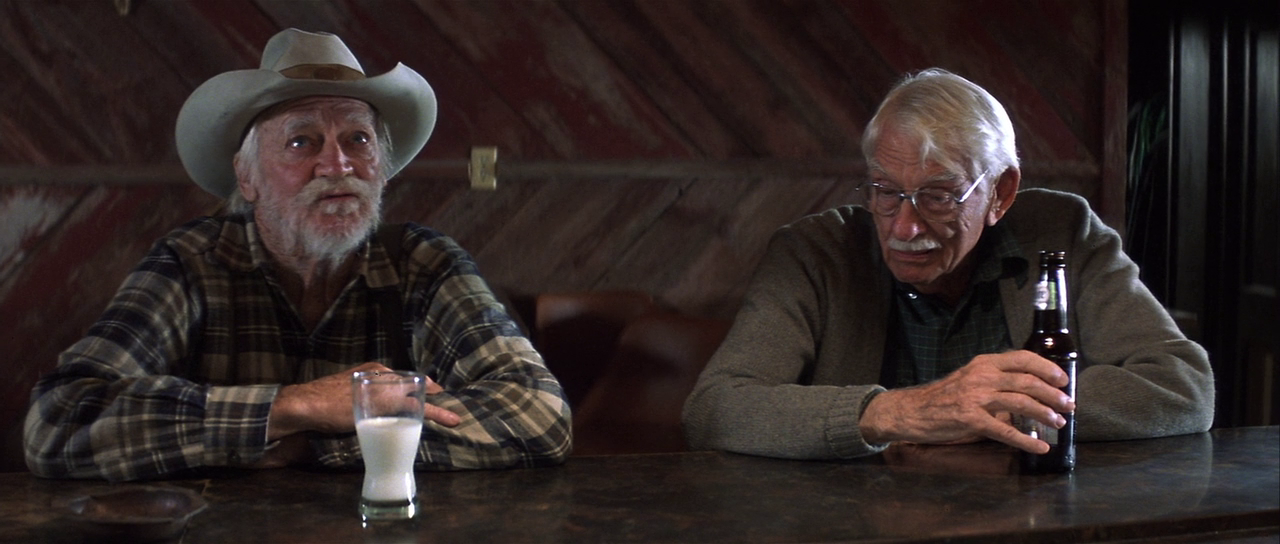
 Especially Alvin. Looking like a crumpled road map, actor Richard Farnsworth shows us a man who's learned that every moment of life is a gift. It's a majestic performance. Alvin's stubborn grace and casual dignity brings out the best in everyone he meets (a pregnant runaway, a hysterical driver who claims to have run over 14 deer). Through his marble-blue eyes and Lynch's camera, the ordinary world starts looking like a thing of wonder. Filming the midwest in its autumnal glory – wheat fields and sunsets, lightning and gentle rain – Lynch transforms a geriatric road trip into a gentle American parable that's quietly awestruck by life itself.
The emotion hits you like a left hook; you just don't see it coming. As Alvin shares his haunted memories of the second world war with a fellow veteran, The Straight Story delivers an anti-war message stronger than a thousand movies about conflict.
 
Suddenly, an old man on a lawnmower doesn't seem so strange. No stranger than it should be to learn that The Straight Story, shot along the route taken by the real Alvin Straight, is a true story. Of course it is.
 (Source: The Guardian)

DAVID LYNCH

Born in precisely the kind of small-town American setting so familiar from his films, David Lynch spent his childhood being shunted from one state to another as his research scientist father kept getting relocated. He attended various art schools, married, and fathered future director Jennifer Chambers Lynch shortly after he turned 21. That experience, plus attending art school in a particularly violent and run-down area of Philadelphia, inspired Eraserhead (1976), a film that he began in the early 1970s (after a couple of shorts) and which he would work on obsessively for five years. The final film was initially judged to be almost unreleasably weird, but thanks to the efforts of distributor Ben Barenholtz, it secured a cult following and enabled Lynch to make his first mainstream film (in an unlikely alliance with Mel Brooks), though Elephant Man, The (1980) was shot through with his unique sensibility. Its enormous critical and commercial success led to Dune (1984), a hugely expensive commercial disaster, but Lynch redeemed himself with Blue Velvet (1986), his most personal and original work since his debut. He subsequently won the top prize at the Cannes Film Festival with the dark, violent road movie Wild at Heart (1990), and achieved a huge cult following with his surreal TV series "Twin Peaks" (1990), which he adapted for the big screen, though his comedy series "On the Air" (1992) was less successful. He also draws comic strips and has devised multimedia stage events with regular composer Angelo Badalamenti.

From the beginning of his career, David Lynch quickly established himself as the Renaissance man of modern American filmmaking, an acclaimed and widely recognized writer-director as well as television producer, photographer, cartoonist, composer, and graphic artist. Walking the tightrope between the mainstream and the avant-garde with remarkable balance and skill, Lynch brought to the screen a singularly dark and disturbing view of reality, a nightmare world punctuated by defining moments of extreme violence, bizarre comedy, and strange beauty. More than any other arthouse filmmaker of his era, he enjoyed considerable mass acceptance and helped to redefine commercial tastes, honing a surrealistic aesthetic so visionary and deeply personal that the phrase "Lynchian" was coined simply to describe it.  (Source: Internet)