Jun 15, 2016

19th June 2016; Pavel Lungin's THE ISLAND


THE ISLAND
A film by Pavel Lungin
2006/ Russia/ 112 minutes
5.45 pm / Perks Mini Theater
http://konangalfilmsociety.blogspot.in/

 Russian Orthodox monk Anatoly lives on a remote island in the frigid White Sea, where he is tormented by guilt from a cowardly “sin” committed years ago under Nazi coercion.  Anatoly shovels coal briquettes and pushes wheelbarrows across rickety planks to repent for his iniquities. He considers himself as “stained” by sin, and accordingly neglects his body till it is as unkempt as his soul.


Anatoly doesn’t bathe (despite his soot-coated accommodations), much to the dismay of his fellow monks.  The sailor-turned-saint hopes said reason will cleanse him of sin when his time to leave the world does come.  Other monks—including superior Father Filaret—find Anatoly an obnoxious prankster who speaks in riddles and “cultivates superstition” among laypeople.

The Island is a study of forgiveness (of oneself and others) whose title—poet John Donne might agree—references one man’s inner isolation as well as his geographic remoteness.  And while arctic environs are harsh, director Pavel Lounguine collages some beautiful imagery (all symbolic) here—from craggy rocks and lichen-covered hills to raging waters and charred timbers.  (From Internet)


Pavel Lungin 

Pavel Semyonovich Lungin s a Russian film director.  Lungin worked primarily as a scriptwriter until given the opportunity to direct Taxi Blues at age 40. Lungin was awarded the Best Director Prize at 1990 Cannes Film Festival for the film Taxi Blues starring Pyotr Mamonov. That same year he took up residence in France, while making films in and about Russia with French producers. Two years later, his next film Luna Park would also compete at the 1992 Cannes Film Festival. In 1993 he was a member of the jury at the 18th Moscow International Film Festival.

Lungin’s last film Ostrov (The Island, 2006) is a penetrating drama of sublimation of the soul. According to the official site of Lungin Studio, in the mid October the film-director finished another feature film under the title Cruelty. In 2007 Lungin is going to release Vetka Sireni (Lilacs), a life story of Sergei Rachmaninoff.


Jun 1, 2016

5th June 2016; Kenloach's KESS


KES
A film by Ken Loach
1969 /UK / 110 mins
5th June 2016
5.45 pm / Perks Mini theater
http://konangalfilmsociety.blogspot.in/
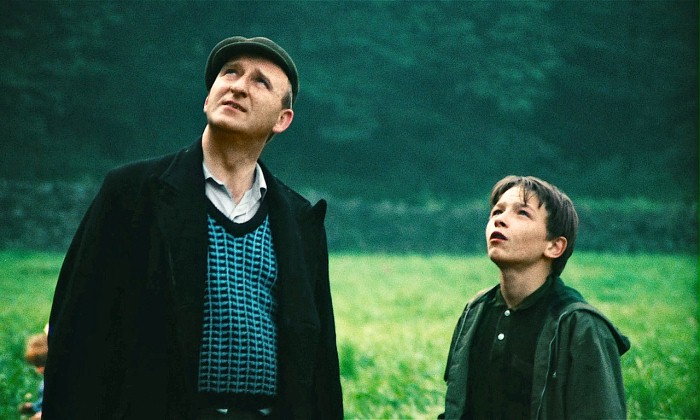
 Director Ken Loach’s masterpiece Kes is the moving and stark portrait of a young boy, Billy, who finds, befriends, tames, and trains a kestrel, aptly named Kes. This boy and this bird, and this film, do not attain, nor do they even seek to begin with, the sort of sentimentality that a movie about a child and an animal can typically denote. It’s much more than that, much more honest than that.

The film follows Billy as he tries to make his way through the grim and at times quite aggressive world of his downtrodden, working-class English town, seeking solace in his time with Kes, finding a refuge from the hostilities of family strife, torment at school, and an otherwise stagnant existence; shots of the bird soaring freely through the overcast skies stand as sharp contrasts and perhaps as sources of envy for the boy who seems to find abuse and confinement at every turn.


Contrasting the desolation and spiritual poverty of Billy's oppressively confining environment against his liberating, almost meditative ritual of kestrel training in the open field, Loach creates a sublimely transitory, yet indelible image of natural communion, existential purpose, and transcendence. 


KEN LOACH

Kenneth Loach (born June 17, 1936, Nuneaton, Warwickshire, England) British film director whose works are considered landmarks of social realism. Loach studied law at St. Peter’s College, Oxford, but while there he became interested in acting. After graduating in 1957, he spent two years in the Royal Air Force and then began a career in the dramatic arts.

Loach continued to address social issues on television and later in theatrical releases as well. In the 1960s Loach directed several docudramas for a television series called The Wednesday Play. One of the productions, Cathy Come Home (1966), explored the disintegration of a working-class family and examined the intertwined issues of unemployment and homelessness. In doing so, it helped bring the discussion of homelessness into the British mainstream. He has been honored with awards and praises for  all over the world ever since.


One can but admire Loach for relentlessly sticking to his task, repeatedly championing the underdog by revealing the hardships and struggles of those at the bottom of the social hierarchy. Few directors have been as consistent in their themes and their filmic style, or as principled in their politics, as Loach has in a career spanning five decades. Without doubt he is Britain's foremost political filmmaker.

May 18, 2016

22nd May 2016 ; Chaitanya Tamhane's 'COURT'


COURT
A film by Chaitanya Tamhane
2014 / Maharashtra/ Marathi / 116 minutes

3 Supplements (5 minutes each) on  ‘COURT’ will be screened
 One  in the beginning and rest after the film


A study in class, bureaucracy, and censorial stupidity, young film maker Chaitanya Tamhane's debut feature, Court, plants viewers in the plastic chairs of an Indian court of law as 69-year-old protest singer Narayan Kamble (Vira Sathidar) is tried for a crime he didn't commit.  
A well- to-do activist lawyer (Vivek Gomber, who has also produced the film) represents Kamble in court while the public prosecutor (Geetanjali Kulkarni) fights tooth and nail to ensure he stays in jail. At one point she even cites archaic laws to claim that the elderly singer is a threat to the sovereignty of India. The defense lawyer knows very well that these laws are antiquated and irrelevant, but apart from being patient and carrying on the fight, there is precious little he can do. 


Beyond criticism of India’s judiciary, the director implicitly implicates the country’s education system, which creates professionals skilled in rote learning yet completely lacking in independent thinking. Where the trial scenes use the legal system’s ponderous rules to hang itself, sequences showing the lawyers outside working hours reveal, via exceptionally nuanced observations, the sorts of influences and lives led by the two sides.

“Court” ends up being a great courtroom drama: it treats the audience as both witness and jury and lays out a sprawling argument for them to ponder over. It’s hard to shake this one off long after the credits have rolled.
( Source:Internet)


Chaitanya Tamhane

Born in Mumbai in 1987, Chaitanya Tamhane is an English literature graduate from Mithibai College of Arts. He has written and directed a feature-length documentary titled FOUR STEP PLAN (2006), chronicling the trends of plagiarism in Indian cinema. His first full-length play as a writer-director, Grey Elephants in Denmark opened to critical acclaim in Mumbai and had several successful shows at prestigious venues. SIX STRANDS (2010), his first fictional short film was screened at various international film festivals including Rotterdam International Film Festival, Clermont Ferrand International Film Festival, Edinburgh International Film Festival, Slamdance, and many others.

Chaitanya’s debut feature film, COURT (2014), premiered at the 71st Venice Film Festival, where it won the Lion of the Future award for best debut and the Orizzonti award for Best film.  Since then, the film has gone on to win 16 international awards at various prestigious film festivals. He was recently featured in Forbes India‘s list of 30 young Indian achievers under the age of 30.

FILMOGRAPHY
COURT / Feature / 2014
SIX STRANDS / Short / 2010
FOUR STEP PLAN / Documentary / 2006


Apr 19, 2016

24th April 2016 ; Wim Wender's WINGS OF DESIRE


WINGS OF DESIRE
A film by Wim Wenders
1987/ Germany/ 129 min
24.04.16 /5.45pm / Perks mini Theater
http://konangalfilmsociety.blogspot.in/


Wim Wender's celestial tribute to life, love, Berlin, filmmaking, angels and the poetry of Rainer Maria Rilke, among many things. .Seen through the (black-and-white) lens of veteran French cinematographer Henri Alekan and reflected in the gentle eyes of Wenders' star angel Bruno Ganz, "Wings" is a soaring vision that appeals to the senses and the spirit.

The angels in “Wings of Desire” are not merely guardian angels, placed on Earth to look after human beings. They are witnesses, and they have been watching for a long time--since the beginning. The film evokes a mood of reverie, elegy and meditation. It doesn’t rush headlong into plot, but has the patience of its angels. It suggests what it would be like to see everything but not participate in it.


We follow two angels: Damiel (Bruno Ganz) and Cassiel (Otto Sander). They listen to the thoughts of an old Holocaust victim, and of parents worried about their son, and of the passengers on trams and the people in the streets; it’s like turning the dial and hearing snatches of many radio programs. the angel Damiel decides that he must become human.He falls in love with the trapeze artist.


"Wings," like most Heaven-and-Earth movies, ties up its resolution with romantic ribbons but, in Wenders' eyes, such a conclusion is the crowning union of life's dual opposites, the sensual and the spiritual, German's East and West -- as well as its Nazi past and occupied and uncertain present . . . It's also one of the best endings you can hope for in a movie. And "Wings" is one of the best movies you can see.  (Source: Internet)


Wim Wenders

Born in Dusseldorf in Germany just after the end of World War II, German film director Wim Wenders grew up with an insatiable appetite for movies. After studying medicine and philosophy in his native country, Wenders took up art study in and then returned to his homeland to attend Munich's Academy of Film and Television. Wenders began his career writing film criticism before directing a few short subjects of his own; in 1970 he and several other young filmmakers formed a production-distribution firm, Filmverlag Der Autoren. Summer in the City (1970) was Wenders' first feature film, but it was his 1973 adaptation of Nathaniel Hawthorne's The Scarlet Letter that first brought him attention outside Germany.

Wenders began his "road movie" cycle, inspired by such American pictures as Easy Rider (1970) and Two Lane Blacktop (1971). Three films in this genre followed in quick succession: Alice in the Cities (1974), The Wrong Move (1975) and Kings of the Road (1976).

 Wenders' American-financed films Hammett (1980) and Paris, Texas (1983) were remarkable in their evocation of time and place.Wenders' return to German filmmaking was rewarded in 1987 with the release of Wings of Desire.

Apr 7, 2016

10th April 2016; Gett: The Trial of Viviane Amsalem


Gett: The Trial of Viviane Amsalem

A film by Ronit and Shlomi Elkabetz
2014 / Israel/ 115 minutes
5.45 pm / 10th April / Perks Mini Theater
http://konangalfilmsociety.blogspot.in/


“Gett, The Trial of Viviane Amsalem” is the story of a woman wronged by men and God, if finally, in a sense, redeemed by cinema. Gett is the Hebrew word for a legal divorce document in Jewish law. This is the ordeal of a woman’s attempt to divorce her husband under the strict religious laws of Israel. There’s no such thing as civil divorce in Israel, where, even today, the termination of a marriage cannot be granted — or even enforced, regardless of grounds — without the husband’s consent.

Shot entirely in the limited space of a courtroom and using uniquely subjective visual aesthetic, “Gett, The Trial of Viviane Amsalem” is Ronit and Shlomi Elkabetz’s third feature film as a directing team. Ronit Elkabetz also stars in the film as Viviane, a character they developed based on their mother’s life.


Viviane — brought to powerful life by Ronit Elkabetz with currents of humility and hauteur — is at once a fleshed-out character, a political metaphor, a shout to heaven and earth. Despite a part requiring long periods of silence, her character’s emotions are as visible — and as changeable — as clouds passing in the sky.

The film depicts the last two years of struggle during which the adamant three-rabbi court tries every means to convince her to remake the couple. The action takes place almost entirely in two rooms, a Jerusalem Bet Din (Rabbinical Court) and its waiting room.  Despite the seemingly uncinematic nature of this inert, even claustrophobic scenario, the film mesmerizes, utterly. It’s at once a feminist film, obviously, and a larger story about diminishing the ultra-Orthodox (Haredi) authority and influence in Israeli life.


Ronit Elkabetz & Shlomi Elkabetz

Israeli film makers  sister-brother duo Ronit and Shlomi Elkabetz have made three films together.

Ronit Elkabetz actress / film maker was the oldest of four children, with three younger siblings who were all brothers. Her younger brother Shlomi, became a director whom she worked with on their trilogy on the life of Viviane Amsalem.Her acting career started in 1991. n May 2010, Ronit Elkabetz received the France Culture award at the Cannes Film Festival, a prize awarded to filmmakers for quality work and social involvement. The judges described her as a "woman teeming with passion and erotica, who can even play the queen of Egypt

Shlomi Elkabetz was born in 1972 in Be'er Sheva,Israel. After completing his military service, he decided he wanted to work in film. He traveled in the Far East and went on to New York, where he remained for seven years. He wrote prose and plays, and also acted; at a certain stage he and Ronit began to write the screenplay for "To Take a Wife," incorporating into it autobiographical elements. In 2000 he returned to Israel. The film, which came out five years later, won various prizes, including the Audience Award at the Venice Film Festival.


Mar 23, 2016

27th March 2016; Kurosawa's HIDDEN FORTRESS


HIDDEN FORTRESS
A film bu Akira Kurosawa
1958/ Jpan/ 39 minutes
27th March /5.45pm / Perks Mini Theater

The Hidden Fortress is a comedy-action epic. It  playfully treats themes that Kurosawa could turn into the grimmest of anatomizations of human nature. Toshiro Mifune is at the fore, but the real focus of the story is on a pair of escaped thieves who, despite their initial bickerings, soon become friends of an almost co-dependent nature. They are captured, but manage to escape in a prisoner riot and go hide in the mountains. While there, they come across two unexpected surprise - gold.


There are many laugh out loud moments in Hidden Fortress, thanks to the dimwitted pair's antics and the use of Mifune's blustering bravado to intimidate and annoy them.In addition, the film also bears some of Kurosawa's finest action sequences since Yojimbo, which include Mifune chasing down two escaping enemies on horseback with a two-handed grip katana smackdown at the end of the ride, and a protracted but excellent spear Deul between Rokurota and a general of the opposing army.


The Hidden Fortress was cited by George Lucas as the basis of Star Wars—chiefly in the way the story unfolds through the eyes of two comic characters. Kurosawa has differentiated The Hidden Fortress from nearly every similar feudal era Japanese epic ever committed to the screen. THE HIDDEN FORTRESS should leave you with a smile on your face and almost wishing it would keep going.


Akira Kurosawa

Akira Kurosawa was the youngest of seven children, born in Tokyo on 23 March 1910. A talented painter, he enrolled in an art school that emphasized Western styles. Around this time he also joined an artists' group with a great enthusiasm for nineteenth-century Russian literature, with Dostoevsky a particular favourite. Another influence was Heigo, one of his brothers, who loved film and worked as a benshi, a film narrator/commentator for foreign silent films. His suicide deeply affected the director's sensibilities.

In 1930 he responded to a newspaper advertisement for assistant directors at a film studio and began assisting Kajiro Yamamoto, who liked the fact he knew 'a lot about things other than movies'. Within five years he was writing scripts and directing whole sequences for Yamamoto films. In 1943 he made his debut as a director with Judo Saga (Sanshiro Sugata), with a magnificent martial-arts sequence.
His early films were produced during the Second World War, so had to comply to themes prescribed by official state propaganda policy. It was Drunken Angel which was Kurosawa's first personally expressive work, made in 1948 and featuring Toshiro Mifune who became Kurosawa's favourite leading man.

For those who discover Kurosawa, they will find a master technician and stylist, with a deep humanism and compassion for his characters and an awe of the enormity of nature. He awakened the West to Japanese cinema with Rashomon, which won the top prize in the Venice Film Festival of 1951, and also a special Oscar for best foreign film. A golden period followed, with the West enthralled by his work. Seven Samurai, Yojimbo etc.

A true auteur, he supervised the editing of nearly all his films and wrote or collaborated on the scripts of most. His memoirs were published in 1982, titled Something like an Autobiography. In 1989 he won an Oscar for Lifetime Achievement. Kurosawa died in 1998.


Mar 3, 2016

6th March 2016 - TIMBUKTU


TIMBUKTU
A film by Abderrahmane Sissako
2015 / Mauritania / 97 minutes
5.45 pm at Perks Mini Theater
http://konangalfilmsociety.blogspot.in/


Abderrahmane Sissako's passionate and visually beautiful film Timbuktu is a cry from the heart – with all the more moral authority for being expressed with such grace and such care. It is a portrait of the country of his childhood, the west African state of Mali, and in particular the city of Timbuktu, whose rich and humane traditions are being trampled by fanatical jihadis, often from outside the country.


The story revolves around the death of a cow, affectionately named "GPS" – an appropriate symbol for a country that has lost its way. A great deal of the film is focused on a family of cattle herders living in the dunes outside of Timbuktu, the paterfamilias of which, Kidane (Ibrahim Ahmed), comes under jihadist judgment in the aftermath of a conflict with a local fisherman over the killing of a cow.


The new puritans appal the local imam, who has long upheld the existing traditions of a benevolent and tolerant Islam; they march into the mosque carrying arms.  Timbuktu is no longer tombouctou la mysterieuse, the magical place of legend, but a harsh, grim, unforgiving place of bigotry and fear.


Abderrahmane Sissako confirms his status as one of the true humanists of recent cinema with this stunningly shot and deeply empathetic drama. In the hands of a master, indignation and tragedy can be rendered with clarity yet subtlety, setting hysteria aside for deeper, more richly shaded tones. Sissako is just such a master, and while previous films have showcased his skill at bringing magnetic dignity to his characters, “Timbuktu” confirms his status as one of the true humanists of recent cinema.


Abderrahmane Sissako

Abderrahmane Sissako was born in Kiffa, Mauritania, in 1961 and raised in Mali, his father’s homeland. When he returned to Mauritania in 1980, the emotional and financial difficulties of adjustment made him turn to literature and film. A study grant allowed him to attend the Institute of the University of Moscow. Le Jeu (1989), first presented as a graduation assignment, won the prize for best short at the Giornate del Cinema Africano of Perugia in 1991. In 1993, October was shown at Locarno and won prizes the world over. His film Waiting for Happiness was screened at Cannes 2002 and was winner of the FIPRESCI award for best film in the Un certain regard section.

Sissako is, along with Ousmane Sembène, Souleymane Cissé, Idrissa Ouedraogo and Djibril Diop Mambety, one of the few filmmakers from Sub-Saharan Africa to reach a measure of international influence. His 2014 film Timbuktu was selected to compete for the Palme d’Or in the main competition section at the 2014 Cannes Film Festival, garnered a 2015 Academy Award nomination for Best Foreign Language Film, and swept the 2015 Cesar Awards in France winning seven awards, including Best Director and Best Film.