Feb 15, 2016

21st Feb 2016; Robert Bresson's AU HASARD BALTHAZAR


Au Hasard Balthazar
A film by Robert Bresson
1966/ France/ 95 minutes
21st Feb 2016/ 5.45 p.m / Peks mini theater
http://konangalfilmsociety.blogspot.in/


Great French master Robert Bresson is one of the saints of the cinema, and "Au Hasard Balthazar" (1966) is his most heartbreaking prayer. The film's title character/protagonist is a donkey -- not a humanoid, Disney donkey but a realistic animal who, in the film's opening sequence, is adopted by three young children in rural southern France and "baptized" in their own makeshift religious ceremony.


Balthazar is a farm animal - a donkey - born into a life of servitude: a beast of burden destined to work the land, carry bales of hay and provide occasional transportation. His harsh, often exploited existence is paralleled through the life of Marie, a reticent young woman whose father has been asked to maintain a friend's farm. The owner's son, Jacques, returns to the farm to profess his support for Marie's father, whose reputation has been ruined by  debt and rumors surrounding the ownership  of the farm. Jacques is devoted to Marie, but Marie is drawn to Gerard, a cruel young man. Meanwhile Balthazar's ownership passes hands to a baker and to Gerard and so on.

French new wave  film maker Godard’s famous claim that Au hasard Balthazar is “the world in an hour and a half” suggests how dense, how immense Bresson’s brief, elliptical tale about the life and death of a donkey is. The film’s steady accumulation of incident, characters, mystery, and social detail, its implicative use of sound, offscreen space, and editing, have the miraculous effect of turning the director’s vaunted austerity into endless plenitude, which is perhaps the central paradox of Bresson’s cinema. So concentrated and oblique is Balthazar, it achieves the density, to extend Godard’s metaphor just a little, of an imploded nova.

Au Hasard Balthazar is a haunting, subtly disturbing, and thematically uncompromising portrait of man's innate cruelty and destructive impulses. Through the transfiguration of a mistreated animal as an allegorical symbol of virtue, purity, and redemption, Robert Bresson creates a visually spare and indelible film of startling intensity: the symbolic image of Marie, Gerard, and Balthazar in the snow; the framed shot of a humiliated Marie against the back closet of the farmhouse; the final, sublime shot of Balthazar with the grazing sheep. Alone in the countryside, wandering and without direction, Balthazar finds a place of peace...his sanctuary. (Source: Internet) 


Robert Bresson 

Robert Bresson’s 13 features over 40 years constitute arguably the most original and brilliant body of work over a long career from a film director in the history of cinema. He is the most idiosyncratic and uncompromising of all major filmmakers, in the sense that he always tried to create precisely what he wanted without surrendering to considerations of commerce, audience popularity, or people’s preconceptions of what cinema should be. And although it might be argued that his venture into colour from Une Femme douce (1969) onwards was probably against his better judgement, he shows mastery in its use.

Born in central France and educated in Paris, Bresson’s early ambition was to be a painter. He ventured into filmmaking with the short Les Affaires publiques (1934). a satire with nods to Clair and Vigo, which was rediscovered in the 1980s after being thought lost. After a year or so as a prisoner-of-war he was approached by a Paris priest with a proposal for a film about the Bethany order of nuns, which became Les Anges du péché (1943). His next feature was also made during the Occupation, and filmmaking had by then definitely supplanted painting. The confusion over his date of birth, symbolic perhaps of his reclusive nature, caused reviewers of his final filmL’Argent (1983) to marvel over how a man "in his late 70s" or alternatively "in his 80s" could show such youthful exuberance in his filmmaking.


A critic once wrote that Mizoguchi’s Sansho Dayu (1954) "is one of those films for whose sake the cinema exists". For many of us, the same can be said of the work of Robert Bresson.

Feb 3, 2016

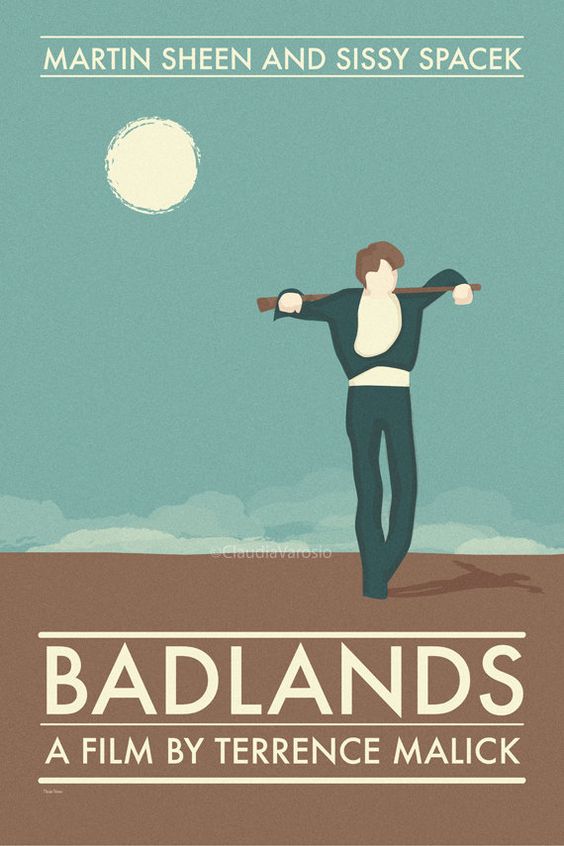
7th Feb 2016; Terrence Malick's BADLANDS


BADLANDS
A film by Terrence Malick
1973/ USA / 93 minutes
5.45 pm/ 7th Feb 2016
Perks Mini Theater


The world was like a faraway planet, to which I could never return ... I thought what a fine place it was, full of things that people can look into and enjoy.
– Holly (Sissy Spacek) in Badlands
 

When making a film, Terrence Malick speaks to his collaborators in poetic images. To Martin Sheen in Badlands (1973), he said: ‘Think of the gun in your hand as a magic wand.’


Among the great American crime movies, 1973's "Badlands" stands alone. It’s main characters Kit and Holly are inspired by real life  Charles Starkweather and Caril Ann Fugate who went on a wild ride in 1958 that ended with eleven people shot dead. Reclusive writer-director Terrence Malick  gives no psychological explanation and there are no symbols to note or lessons to learn from the movie. What comes through more than anything is the enormous loneliness of the lives these two characters lived, together and apart. He interweaves dull stretches of South Dakota and Montana with fierce young love, giving the film a chilling and spellbinding realism.


Nature is always deeply embedded in Malick’s films. It occupies the stage and then humans edge tentatively onto it, uncertain of their roles. Kit is ten years older than Holly, but they’re both caught up in the same adolescent love fantasy at first. 


Kit and Holly are fleeing toward nowhere, although Kit talks vaguely of “heading north”. Holly follows along not so much because she must, but because she had a crush on Kit and hated her father who angered her by forbidding her to see him and even shot her dog to punish her. Refracted through Holly’s naive, emotionally flat narration and Malick’s poetic visual style, this tale is transformed into something strange and oddly beautiful.  


Kit and Holly are fleeing toward nowhere, although Kit talks vaguely of “heading north”. Holly follows along not so much because she must, but because she had a crush on Kit and hated her father who angered her by forbidding her to see him and even shot her dog to punish her. Refracted through Holly’s naive, emotionally flat narration and Malick’s poetic visual style, this tale is transformed into something strange and oddly beautiful.

Scenes from "Badlands" just never leave you. There's a constant tension between the beauty of the landscapes -- and of Holly and Kit -- and the banality or craziness of their behavior.  Terrence Malick's debut film "Badlands" captivates us  with its unique blend of deadpan lyricism, eerie violence and wistful romanticism. (Source:Internet)


Terrence Malick

Malick grew up in Bartlesville, Oklahoma and Texas, working on oil fields as a young man. He moved to Austin, Texas and graduated from St. Stephen's Episcopal School. Malick studied philosophy under Stanley Cavell at Harvard University, graduating summa cum laude and Phi Beta Kappa in 1965. He went on to Magdalen College, Oxford as a Rhodes Scholar. After a disagreement with his advisor, Gilbert Ryle, over his thesis on the concept of the world in Kierkegaard, Heidegger, and Wittgenstein, Malick left Oxford without a doctorate degree.

In 1969, Northwestern University Press published Malick's translation of Heidegger's Vom Wesen des Grundes as The Essence of Reasons. Moving back to the United States, Malick taught philosophy at Massachusetts Institute of Technology while freelancing as a journalist. He wrote articles for Newsweek, The New Yorker, and Life.

Malick got his start in film after earning an MFA from the AFI Conservatory in 1969, directing Lanton Mills. At the AFI he established contacts with people such as Jack Nicholson and agent Mike Medavoy, who acquired freelance script-doctoring work for him. After working as a screenwriter and script doctor, Malick directed Badlands (1973) and Days of Heaven (1978). Following the release of Days of Heaven, Malick moved to France and disappeared from public view for 20 years. He returned to film in 1998 with The Thin Red Line. The movie was nominated for seven Academy Awards, but did not win any of them.

His fourth feature was The New World, whose script he finished in the late 1970s. The film features a romantic interpretation of the story of John Smith and Pocahontas, filmed in his customary transcendental style. And nextcame his great  master piece Tree of Life in 2011. Malick is famously reclusive. His contracts stipulate that no one may photograph, and he routinely declines requests for interviews. Malick married Alexandra "Ecky" Wallace in 1998. They reside in Austin, Texas.

(Source:Internet)

Jan 20, 2016


THE ROOF
A film by Vittorio De Sica
1956 / Italy/ Runtime: 95 minutes
24th Jan 2016/ Perks Mini Theater


THE ROOF, largely considered the last masterpiece of Italian Neorealist cinema, dramatizes a single night in the lives of Luisa and Natale, a strikingly good-looking but destitute pair of newlyweds. The couple share a small two-room apartment with several relatives. 

Following a bitter family dispute, Luisa and Natale pack out of this untenable living situation. Luisa turns to a friend for housing, while Natale finds shelter in a tool shed. Realizing that separation is no solution, the couple struggles to build a small shack for themselves.

With very little money or possessions, the young couple struggle to find appropriate accommodation anywhere in the city. All around Rome, squatters are building meager shacks on unclaimed land. This illegal practice is heavy patrolled by officials and if discovered during construction, the authorities order the immediate demolition of the structure. 

Natale works as an apprentice bricklayer and is aware of the Italian law, which stipulates that once a roof is completed on a dwelling, the authorities cannot pull it down.

In an era of economic hardship, how does a newly married young couple gain independence and break the necessity of living with relatives in an over-populated household? Winner of the OCIC Award at Cannes in 1956, The Roof is a memorable, heartwarming tale of love and community amid tough economic times. (Source:Internet)


Vittorio De Sica

Vittorio De Sica, was one of the great directors of the postwar Italian neorealist movement, which represented a large, loud break with Hollywood tradition and dealt with life as it might exist outside sound stages. As one of the world's most influential filmmakers, and as an actor who starred in some 150 movies, Vittorio De Sica built a remarkable film career that spanned half a century. De Sica directed 34 feature films, for which he won numerous international prizes. He was honored with four Academy Awards: two Special Awards, preceding the creation of the Best Foreign Film category, for "Shoeshine" in 1947, and "The Bicycle Thief" in 1949, and Best Foreign Film Awards for "Yesterday, Today and Tomorrow" in 1964, and The Garden of the Finzi-Continis in 1971.

De Sica was born in 1902 in Sora, near Rome, and grew up in Naples in a middle-class family. His career took off in the 1920s whenhe joined a local theater company and became a matinee idol. He later formed his own company, producing plays and co-starring with his first wife, Giuditta Rissone During World War II, De Sica turned to directing. His first four films were routine light productions in the tradition of the Italian cinema of the day. But his fifth, "The Children Are Watching Us," was a mature, perceptive, and deeply human work about the impact of adult folly on a child's innocent mind. The film marked the beginning of De Sica's collaboration with author and screenwriter Cesare Zavattini, a creative relationship that was to give the world two of the most significant films of the Italian neorealism movement, "Shoeshine" and "The Bicycle Thief."    Some more great films followed. Vittorio De Sica died in 1974 at the age of 72.

 .                                                                                    


Jan 5, 2016

10th January 2016; Tati's Mon Uncle


MON ONCLE
A film by Jacques Tati
1928/ France/117 mins/ Col
5.45 pm; 10th Jan 2016 / Perks Mini theater
http://konangalfilmsociety.blogspot.in/


Jacques Tati (1909-1982) only made six features and yet he ranks with the great silent clowns among masters of visual comedy. With Mon Oncle master comedian Jaquese Tati weaves a series of physical gags into a social commentary, creating a rich comedy that can be enjoyed both by casual and intellectual audience. 


For Tati the joke is almost more about the setup than the payoff. Each gag has a meticulous setup that makes the joke all the richer "Mon Oncle" is halfway a silent film, with the dialogue sounding like an unexpected interruption in a library. The music is  simple, cheerful, like circus music while we're waiting for the clowns.


The hero of this tale is Tati’s signature character, Monsieur Hulot, also played by Tati. This small town man lacks grace but makes up for it in heart.  He is often seen in a brown fedora, a tan raincoat, a bow tie, too short pants, striped socks and with his long-stemmed pipe. He hardly ever says anything.

Mr. Hulot  is a lost soul, unemployed, bemused and confused by the modern world. His sister Madame Arpel lieves wants to  help him. She lives with her husband Monsieur Arpel and their young son Gerard n a futuristic architectural monstrosity, and a great deal of the movie's time is spent exploring their cold new world.

"Mon Oncle" introduces us casually to a large cast of local characters, including a street-sweeper who is perpetually in conversation and always means to use his broom but never does, and a produce vendor . There is a tender, subtle subplot involving Betty, the concierge's daughter. There's also a supporting cast of dogs, who are seen in the first shot and the last, and hurry on their doggy business in between. They don't have an important role in the plot; they're just there, checking things out, marking their territory.

Just reach back, take Mon Oncle's hand and head out around the block wherever you live. You never really know just what it is you'll discover on your next stroll through the neighborhood.  (Sorce : Internet) 


Jacques Tati

There are not many filmmaking legends whose entire output can be counted on the fingers of both hands, but this towering, graceful, pipe-puffing auteur, a comedic genius, achieved his reputation on the basis of just six feature films. His theme, his style, his mise-en-scène, all suggested the eternal struggle between Man and Machine; his was a kind of intricate slapstick in which characters found themselves at the mercy of progress, and his affinity for silent-screen comedy was mirrored in his own nearly total abstinence from dialogue (though his uses of natural sound and comic sound effects were nonpareil). In his first feature, Jour de Fete (1949), Tati played a village postman obsessed with modernizing his already-simple job. Four years later, in Mr. Hulot's Holiday (1953), he introduced the umbrella toting, raincoat-clad Mr.Hulot. It was an international smash, and Hulot became Tati's screen alter ego for much of the remainder of his career.

In Mon Oncle (1958), Tati's first color film, Hulot is victimized by an automated house in which-you guessed-everything goes wrong. (It won the Oscar for Best Foreign Film.) He spent years working on Playtime (1967), shot on 70mm film, which pitted Hulot and a group of tourists against the high-tech vagaries of modern Paris, with an extended climax at the opening of a chi-chi restaurant where-that's right-everything goes wrong. Critics hailed it a masterpiece, but it was not a financial success, and a devastated Tati only made two more (small) films before retiring: Traffic (1972), with Hulot traveling to a modern auto show, and Parade (1974), a quasi-documentary showcasing French cabaret acts, with Tati recreating some of his old music-hall routines. He also made a gag cameo appearance as Hulot in Truffaut's Stolen Kisses (1968).  It's lamentable that he left behind so few films, but any five minutes of any of them is sufficient to restore his spirit. (Source: Internet)


Dec 23, 2015


KWAIDAN
A film by Masaki Kobayashi
1964 / Japan / 183 mins / Col
5.45pm /27th Dec 2015/ Perks Mini Theater


 Masaki Kobayashi's Kwaidan – which offers a four ghost stories based on old Japanese folk tales is one of the most meticulously crafted supernatural fantasy films ever made, and it  is also one of the most unusual.  This is a  a four-part, three-hour epic that turns each of its tales into full-blown cinematic symphonies. Kwaidan is based on the writings of Lafcadio Hearn, a folklorist of Greek-Irish ancestry who  became a naturalized Japanese citizen in 1895, and changed his name to Yakumo Koizumi. As directed by Kobayashi, Hearn’s four tales unfurl across the screen like versions of the classic Japanese paintings of the historical periods in which the film is set.


Kwaidan’s  four short supernatural stories (Black Hair, Hoichi the Earless, In a Cup of Tea and The Woman of the Snow ) all involve an encounter with a ghost's presented in a highly stylized and intellectual manner, that serves up a colorfully exotic offering. The film's plusses are its strong imagery, haunting atmosphere and some memorably striking spooky moments. The best story is titled "Hoichi the Earless" and tells about a blind biwa player (Katsuo Nakamura) called by the spirits to recite his tale of the doomed Heike clan's defeat by their rival Taira clan to a samurai ghost.


"Black Hair" is the tale of a samurai (Rentaro Mikuni) who returns to the wife he deserted for a selfish, wealthy woman some time ago and, after sleeping with the neglected woman, discovers her skeletal remains in his bed and goes raving mad.


"The Woman of the Snow" is a story cut from the theatrical releases abroad but was restored when the film was released on DVD. A young apprentice woodcutter (Tatsuya Nakadai) is saved from death by a mysterious snow maiden who vows to kill him should he ever blab about what went down, as she kills his woodcutter boss with her breath. "In a Cup of Tea" A guard (Ganemon Nakamura) sees a samurai's face in his teacup and absorbs the ghost's soul into his body after drinking the tea.


The film took five years to make and was the most expensive Japanese film to date. It won the Jury Prize at Cannes in 1965. Kaidan seizes on the both the analytical relevance and the irreducible poetry of the tradition it invokes. Despite the longeurs, it provides one of the richest, most entrancing cinema experiences around. (Source:Internet)


Masaki Kobayashi

Masaki Kobayashi is one of Japan's most outstanding  humanist filmmakers. A contemporary of Akira Kurosawa and Kon Ichikawa, Kobayashi's personal experience of the Second World War has marked his pictures with a deep concern for social justice. His most acclaimed films are unflinching explorations into the dark side of Japanese culture, the side that drove men to commit gory suicide for the name of honor and commit horrific atrocities in the name of the Emperor. Kobayashi's exacting professionalism makes his films a visually and emotionally power experience.

Born in February, 1916, in Japan's northern-most island Hokkaido, Kobayashi entered prestigious Waseda University in 1933 . Kobayashi eventually left Waseda to enter Shochiku's Ofuna studios. Kobayashi worked as an assistant for a mere eight months before he was drafted and sent to the front in Manchuria. Opposed to the war, which he viewed as senseless, he refused to rise above the position of private. In 1944, he was transferred to the southern Ryukyu Islands, where he witnessed the war's final bloody tumult. There he was captured by the U.S. and held for a year in a detention camp in Okinawa.

In the fall of 1946, Kobayashi returned to Shochiku and served for six years as an assistant director under Keisuke Kinoshita. He garnered international acclaim and a prestigious San Giorgio prize at the Venice Film Festival in 1960 for his Human Condition I: No Greater Love (1958), the first installment of sweeping trilogy about the war. Kobayashi's films brought to life by the masterful performances of Nakadai in such Kobayashi classics as Harakiri (1962), Kwaidan (1964), and Samurai Rebellion (1967).With the acclaimed Kwaidan, his first color film, he pushed this emphasis on composition with his expressionistic use of color. Kobayashi died in of a heart attack in 1996.

(Source:Internet)

Dec 11, 2015

13th Dec2015; Hitchcock's SHADOW OF A DOUBT


SHADOW OF A DOUBT
A film by Alfred Hitchcock
1943/ USA/ 108 min
13th Dec, 2015; 5.45pm; Perks Mini Theater
http://konangalfilmsociety.blogspot.in

Screening starts exactly at 5.45 pm with a documentary on Hitchcock


Shadow of a Doubt is a disturbing and relentlessly modern look at the corruption of small town American life. In an era when the movies all but had to portray only positive images of this country, Alfred Hitchcock was testing the limits of decency and morality as defined by Hollywood’s Production Code. Hitchcock takes the all-American family and introduces malice so true it consumes.

The horror is, of course, Uncle Charlie. He visits his sister and her family in Santa Rosa, California, and develops a strange relationship with his niece, Charlotte, affectionately referred to as Charlie in honor of her uncle. She soon suspects her Uncle Charlie of being the Merry Widow murderer and is plunged into turmoil over her family obligations and the vulgarity of his acts.

When we’re first introduced to the Newton family, it’s a kind of clichéd look at bucolic family life. Everybody is nice and genteel and pleasant. This might appear dated when we, less as Americans and more as human begins, know that this isn’t the reality of daily life. But the light atmosphere Hitchcock cultivates in the film’s early scenes heightens the dark aspects of the story to follow, dark like the column of smoke snaking behind Uncle Charlie’s train.

Ultimately, Shadow of a Doubt remains one of Hitchcock’s best movies because it is a clear example of the director’s sense of the world. From out of the censored studio era, it’s refreshing that an artist could commit to celluloid a personal, cynical voice. Nothing, it seems, is as it should be in a Hitchcock film. While his films are certainly nail biters, the reason Hitchcock was so great was because he understood the human condition and its flaws. (Source: Internet)


Alfred Hitchcock

Alfred Hitchcock is known to his audiences as the 'Master of Suspense' and what Hitchcock mastered was not only the art of making films but also the task of taming his own raging imagination. Director of such works as Vertigo, Psycho, The Birds and The 39 steps, Hitchcock told his stories through intelligent plots witty dialogue and a spoonful of mystery and murder. In doing so, he inspired a new generation of filmmakers and revolutionized the thriller genre, making him a legend around the world. His brilliance was sometimes too bright: He was hated as well as loved, oversimplified as well as over analyzed. Hitchcock was eccentric, demanding, inventive, impassioned and he had a great sense of British humor. 


His success followed when he made a number of films in Britain such as "The Lady Vanishes" (1938) and Jamaica Inn (1939), some of them which also made him famous in the USA. David O. Selznick, an American producer at the time, got in touch with Hitchcock and the Hitchcock family moved to the USA to direct an adaptation of Daphne du Maurier's Rebecca (1940). It was when Saboteur (1942) was made, that films companies began to call his films after him; such as Alfred Hitchcock's Psycho, Alfred Hitchcock's Family Plot, Alfred Hitchcock's Frenzy.He retired soon after making Family Plot (1976).In late 1979, Hitchcock was knighted, making him Sir Alfred Hitchcock. On the 29th April 1980, 9:17AM, he died peacefully in his sleep