Apr 11, 2011

17th April 2011; Peter Weir's Picnic at Hanging Rock

Picnic at Hanging Rock
A film by Peter Weir
Year: 1975
Country : Australia
Run time:115 minutes
English with English subtitles
17th April 2011; 5.45pm
Perks Mini Theater

On a drowsy St. Valentine's Day in 1900, a party of girls from a strict boarding school in Australia goes on a day's outing to Hanging Rock, a geological outcropping not far from their school. Three of the girls and one of their teachers disappear into thin air. One of them is found a week or so later, but can remember almost nothing. The others are never found.
On this foundation, Peter Weir's "Picnic at Hanging Rock" (1975) constructs a film of haunting mystery and buried sexual hysteria. It also employs two of the hallmarks of modern Australian films: beautiful cinematography and stories about the chasm between settlers from Europe and the mysteries of their ancient new home.
The movie is based on a 1967 novel by Joan Lindsay, then 71, who presented it as fiction but hinted that it might be based on fact. A cottage industry grew up in Australia about the novel and the movie; old newspapers and other records were searched without success for reports of disappearing schoolgirls.
Did the girls disappear into another time line? Were they raped by two teenage boys who were also on Hanging Rock that day? Did they simply fall into a crevice? What about the girl who was found alive a week later?

"We worked very hard,'' Weir told an interviewer for Sight & Sound, "at creating an hallucinatory, mesmeric rhythm, so that you lost awareness of facts, you stopped adding things up, and got into this enclosed atmosphere. I did everything in my power to hypnotize the audience away from the possibility of solutions.''
Visually it probably is one of the most beautiful picture ever seen, with Australian flora and fauna and wonderful blue skies. Everything has been carefully re-created with loving exactitude.
(Sorce : Internet )


Peter Weir

Peter Weir helped to define the rebirth of Australian cinema, while addressing some of the most pressing concerns of the nation in the 1970s and 1980s. His intriguing images of Australia, evocative and transcendent, made an impact in the international art house scene, eager for compelling visions of geo-political areas and cultures overlooked by mainstream cinema. After achieving international recognition as an emblematic Australian filmmaker, Weir made his transition to Hollywood while maintaining a sense of experimentation and artistic exploration. His films, including his Hollywood ones, cannot be pigeonholed in terms of themes, genres or geographical locals; but they do display an approach to filmmaking, a sensibility, a drive, that amount to one of the most searching trajectories in contemporary cinema.

Weir was born in Sydney. attended The Scots College and Vaucluse Boys' High School before studying art and law at the University of Sydney. His interest in film was sparked by his meeting with fellow students, including Phillip Noyce and the future members of the Sydney filmmaking collective Ubu Films.After leaving university in the mid-1960s he joined Sydney television station ATN-7.Weir then took up a position with the Commonwealth Film Unit (later renamed Film Australia), for which he made several documentaries.After leaving the CFU, Weir made his first major independent film, the short feature Homesdale (1971), an offbeat black omedy.Weir's first full-length feature film was the underground cult classic, The Cars That Ate Paris (1975), a low-budget black comedy about the inhabitants of a small country town who deliberately cause fatal car crashes and live off the proceeds.

Weir's major breakthrough in Australia and internationally was the lush, atmospheric period mystery Picnic at Hanging Rock (1975), made with substantial backing from the state-funded South Australian Film Corporation and filmed on location in South Australia and rural Victoria. Weir's next film, The Last Wave (1977) was a supernatural thriller.Between The Last Wave and his next feature, Weir wrote and directed the offbeat low-budget telemovie The Plumber (1979).Weir scored a major Australian hit and further international praise with his next film Gallipoli (1981). Gallipoli was instrumental in making Mel Gibson (Mad Max) into a major star.The climax of Weir's early career was the $6 million multi-national production The Year of Living Dangerously (1983).On 14 June 1982, Weir was appointed a Member of the Order of Australia (AM) for his service to the film industry.

Weir's first American film was the successful thriller Witness (1985),It was followed by the darker, less commercial The Mosquito Coast (1986), Paul Schrader's adaptation of Paul Theroux's novel. Weir's next film, Dead Poets Society (1989) was a major international success. Next came Green Card and Fearless. After five years, Weir returned to direct his biggest success to date,The Truman Show (1998), a bittersweet fantasy-satire of the media's control of life. In 2003 Weir returned to period drama with Master and Commander: The Far Side of the World, starring Russell Crowe. Weir wrote and directed ‘The Way Back’ which was released in late 2010.
(From Wikipedia)

Mar 28, 2011

2nd April 2011; Henri Matisse , Louis Bourgeois -Documentaries on Art

Contemplate & Konangal present
Documentaries on Art


Henri Matisse
and
Louis Bourgeois

2nd April, 2001 5.45pm
Contemplate Art Gallery,
IIfloor, Rajshree Ford Bldg,
Avanashi Road
(opp) Krishnammal College


Louis Bourgeois
1911 to 2010

(13 minutes – segment from Art 21 series)

A brief introduction to Louis Bourgeois. - renowned French-American artist and sculptor,best known for her contributions to both modern and contemporary art, and for her spider structures, titled Maman, which resulted in her being nicknamed the Spiderwoman. She is recognized today as the founder of confessional art.

Louise Bourgeois was born in Paris in 1911 and died in 2010. Bourgeois studied math at the Sorbonne, then studied art at the Ecole des Beaux-Arts and the Grande Chaumiere in Montparnasse.

Bourgeois has worked in marble, wood, paint, bronze, plaster and latex. In the In the late 1940s, after moving to New York City with her American husband, Robert Goldwater, she turned to sculpture. Though her works are abstract, they are suggestive of the human figure and express themes of betrayal, anxiety, and loneliness.

1940s, she produced several tall, thin wooden abstract sculptures. Her later work remains abstract but makes more overt references to the body.


Henri Matisse

The art of our century has been dominated by two men: Henri Matisse and Pablo Picasso. They are artists of classical greatness, and their visionary forays into new art have changed our understanding of the world. Matisse was the elder of the two, but he was a slower and more methodical man by temperament and it was Picasso who initially made the greater splash.
Matisse, like Raphael, was a born leader and taught and encouraged other painters, while Picasso, like Michelangelo, inhibited them with his power: he was a natural czar.
Matisse's artistic career was long and varied, covering many different styles of painting from Impressionism to near Abstraction. Early on in his career Matisse was viewed as a Fauvist, and his celebration of bright colors reached its peak in 1917 when he began to spend time on the French Riviera at Nice and Vence. Here he concentrated on reflecting the sensual color of his surroundings and completed some of his most exciting paintings.
In 1941 Matisse was diagnosed as having duodenal cancer and was permanently confined to a wheelchair. It was in this condition that he completed the magnificent Chapel of the Rosary in Vence.
Matisse's art has an astonishing force and lives by innate right in a paradise world into which Matisse draws all his viewers. He gravitated to the beautiful and produced some of the most powerful beauty ever painted. He was a man of anxious temperament, just as Picasso, who saw him as his only rival, was a man of peasant fears, well concealed.

Both artists, in their own fashion, dealt with these disturbances through the sublimation of painting: Picasso destroyed his fear of women in his art, while Matisse coaxed his nervous tension into serenity. He spoke of his art as being like "a good armchair"-- a ludicrously inept comparison for such a brilliant man-- but his art was a respite, a reprieve, a comfort to him.
(Soure:Internet)
1869 - 1954
(55 minutes documentary on Matisse
Segment from Modern Masters series)

Mar 8, 2011

13th March 2011; Robert Bresson's Mouchette

Mouchette
A film by Robert Bresson
Country: France
Year:1967
French with English subtitles
Runtime:78 minutes
13th March 2011; 5.45 pm
Perks Mini Theater, Perks School
http://konangalfilmsociety.blogspot.com/

Robert Bresson's film, made in 1967, understands the sensitivity of those who have no friends. Mouchette is a girl from an impoverished family. Her mother is dying of cancer. Her father physically abuses her. When the baby cries, she is expected to clean him and feed him. At school, smarter girls tease her for wearing clogs and being a peasant. When she earns money at the tavern for doing odd jobs, her father pockets it. She has nothing.
Bresson's use of spare and minimal camera work serves a greater purpose than to merely provide a signature style. From the extreme close-ups of the opening scene, showing only Arsene and Mathieu's (Jean Vimenet) eyes, to the headless shots of people in the bar, Bresson creates a metaphor for the fractured soul. Mouchette is profoundly alone, incomprehensibly searching for connection and acceptance, but is answered with betrayal and violence.
Bresson always forces the viewer to construct his own, individual diegesis. Bresson argued that when we experience immediate events in our everyday lives, there is no causality. A causal understanding of experience is only produced later, upon reflection.
Bresson wanted the audience to have this direct causal-construction experience with his film narratives, and for this reason he didn’t want his actors (which he preferred to call “models”) to inject their own interpretive causal renderings in their roles.
Mouchette is one of the purest Bressons. Mouchette so abused by everyone in her village that death seems like God's caress, and so maladroit that she must try three times before she succeeds in drowning herself. Its effect as you watch it is beautifully unforgiving; as you recall it, brutally radiant.


Robert Bresson

Robert Bresson’s 13 features over 40 years constitute arguably the most original and brilliant body of work over a long career from a film director in the history of cinema. He is the most idiosyncratic and uncompromising of all major filmmakers, in the sense that he always tried to create precisely what he wanted without surrendering to considerations of commerce, audience popularity, or people’s preconceptions of what cinema should be. And although it might be argued that his venture into colour from Une Femme douce (1969) onwards was probably against his better judgement, he shows mastery in its use.

Born in central France and educated in Paris, Bresson’s early ambition was to be a painter. He ventured into filmmaking with the short Les Affaires publiques (1934), a satire with nods to Clair and Vigo, which was rediscovered in the 1980s after being thought lost. After a year or so as a prisoner-of-war he was approached by a Paris priest with a proposal for a film about the Bethany order of nuns, which became Les Anges du péché (1943). His next feature was also made during the Occupation, and filmmaking had by then definitely supplanted painting. The confusion over his date of birth, symbolic perhaps of his reclusive nature, caused reviewers of his final filmL’Argent (1983) to marvel over how a man "in his late 70s" or alternatively "in his 80s" could show such youthful exuberance in his filmmaking.

Three formative influences in Bresson’s life undoubtedly mark his films: his Catholicism, which took the form of the predestinarian French strain known as Jansenism; his early years as a painter; and his experiences as a prisoner-of-war. These influences manifest themselves respectively in the recurrent themes of free-will versus determinism, in the extreme and austere precision with which he composes a shot, and in the frequent use of the prison motif (two films are located almost entirely inside prisons).

All Bresson’s features after the first have literary antecedents of one form or another, albeit updated. Two are from Dostoevsky (Une Femme douceand Quatre nuits), two from Bernanos (Journal and Mouchette), one from Tolstoy (L’Argent), one from Diderot (Les Dames), while Un Condamné and Le Procès are based on the written accounts of the true events. In addition Pickpocket is clearly influenced by Dostoevsky’s Crime and Punishment and Balthazar has a similar premiss to the same author’s The Idiot. Lancelot du Lac is derived from Malory’s Arthurian legends, while Le Diable probablement (1977) was inspired by a newspaper report, as is stated at the start of the film.

A critic once wrote that Mizoguchi’s Sansho Dayu (1954) "is one of those films for whose sake the cinema exists". For many of us, the same can be said of the work of Robert Bresson.

(Source : Roger Ebert , Senses Of Cinema , Ozu's World Movie Reviews )


Feb 28, 2011

6th March 2011; Abbas Kiarostami's CLOSE-UP

Close-Up
A film by Abbas Kiarostami
Year:1990
Country:Iran
Persian with English subtitles
6th March 2011; 5.45 pm
Perks Mini Theater . Perks School

Close-Up (Nema-ye Nazdik, 1990) was perhaps Abbas Kiarostami’s most critically-acclaimed film, and yet it was apparently something of an opportunistic spur-of-the-moment production that was made without much prior planning.
Close-up opens to a shot of a newspaper reporter (Hossein Farazmand) fetching two police officers on a taxi to go to a house on Golzar Street. A mild mannered, unassuming man (Hossein Sabzian) is led away by the officers as the reporter goes door-to-door in search of a tape recorder for the exclusive interview.
All of the characters are portrayed by themselves, and the story is based of events that actually transpired. The newspapers provide a glimpse into the chaos of the scene - an announcement on the arrest of a "bogus Makhmalbaf" - and Kiarostami (off-camera) begins to conduct interviews with the parties involved.
It is Mr. Sabzian's poignancy that makes "Close-Up" much more than a clever reflection on film-versus-life as an endless hall of mirrors. A transcendent humanist in the tradition of the Italian neo-realists and the Indian director Satyajit Ray, Mr. Kiarostami has made a film that looks into the heart of a man accused of a crime and, instead of evil, discovers only sweetness, longing and a sad confusion.

It is a searingly honest and intensely personal moment for the reverent Sabzian and gracious Makhmalbaf, that the question arises: are we still watching a film or real-life unfold before us? To Abbas Kiarostami, it is all one and the same phenomenon - a captured moment in the evolving document of life.
(Source: Internet)


Abbas Kiarostami

Abbas Kiarostami was born in Tehran, Iran, in 1940. He graduated from university with a degree in fine arts before starting work as a graphic designer. He then joined the Center for Intellectual Development of Children and Young Adults, where he started a film section, and this started his career as a filmmaker at the age of 30. Since then he has made many movies and has become one of the most important figures in contemporary Iranian film. He is also a major figure in the arts world, and has had numerous gallery exhibitions of his photography, short films and poetry. He is an iconic figure for what he has done, and he has achieved it all by believing in the arts and the creativity of his mind.
(Source:IMDB )

Feb 14, 2011

20th Feb 2011; Michelangelo Antonioni's L'Avventura

L'Avventura
A film by Michelangelo Antonioni
Country: Italy
Year: 1960
Italian with English subtitles
Runtime: 143 min
20th Feb 2011
Perks Mini Theater, Perks School

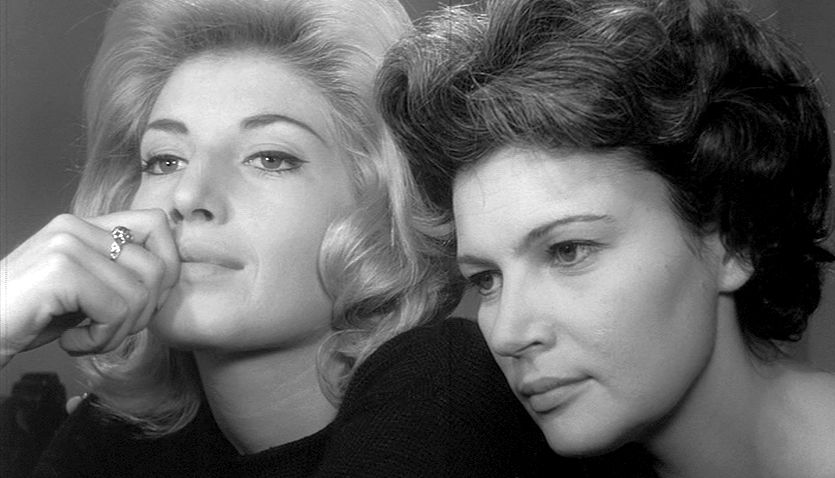
The plot of "L'Avventura'' became famous because, it was said, nothing happened in the movie. What we saw was a search without a conclusion, a disappearance without a solution.

A group of wealthy friends are cruising the sea near Sicily on a yacht. They anchor near an island, swim ashore and begin to explore. Anna (Lea Massari) has quarreled with her lover Sandro (Gabriele Ferzetti), and has been overheard saying she wanted to be left alone. They both go ashore, along with her friend Claudia (Monica Vitti) and others. After a time Anna cannot be found. The others search the island for her; it is mostly rocks and scrubby trees, and there seem few places to hide, but she cannot be found.

The aesthetic marriage of image, performance, and sound (the score is spare, but subtly effective) creates a continuous mood that seems to capture something essential about the human condition. To a certain extent these visual effects go beyond verbal articulation, and Antonioni, himself, has suggested the same thing by shying away from explicit commentary on the film’s meaning. This is evidently what was meant by the Cannes Film Festival Jury Prize’s wording, and also to those who respond to the film’s imagery, when it is said that L’Avventura created “a new movie language”.
Many films are called “classic,” but few qualify as turning points in the evolution of cinematic language, films that opened the way to a more mature art form. Michelangelo Antonioni’s L’Avventura (The Adventure) is such a work. It divided film history into that which came before and that which was possible after its epochal appearance. It expanded our knowledge of what a film could be and do. It is more than a classic, it’s an historical milestone.
(Source:Internet)


Michelangelo Antonioni

Michelangelo Antonioni was born in 1912 into a middle-class family and grew up in bourgeois surroundings of the Italian province. In Bologna he studied economics and commerce while he painted and also wrote criticism for a local newspaper.

In 1939 he went to Rome and worked for the journal "Cinema" studying directorship at the School of Cinema. As he was indebted to neorealism his films reflect his bourgeois roots like in his first movie Cronaca di un amore (1950) or La signora senza camelie (1953) or Le amiche (1955).

His biggest success was the trilogy L'avventura (1960), La notte (1961), and L'eclisse (1962), with which he won several prizes. This success allowed him to go abroad and to work on international scale in English: e.g. Blowup (1966) in London and Zabriskie Point (1970) in the USA as well as Professione: reporter (1975). A stroke in 1985 severely inhibited his productivity until his death in 2007.
(Source:Internet)


Jan 31, 2011

6th Feb 2011; Christian Petzold's YELLA

YELLA
A film by Christian Petzold
Year : 2007
Country : Germany
German with English subtitles
Run time 89 minutes
6th Feb 2011 ; 5.45pm
Perks Mini Theater
Perks School, off Trichy Road
http://konangalfilmsociety.blogspot.com/

Documentary of film maker Christian Petzold’s
interview will follow the main screening


Yella is a reserved young woman with unrevealed depths of intelligence, larceny and passion. Their gradual revelation makes this more than an ordinary thriller, in great part because of the performance of Nina Hoss in the title role.
German writer-director Christian Petzold returns to top form in "Yella," another precision-helmed, tightly wound, metaphysical thriller that confirms him as one of Germany's finest middle-generation directors.
Topped by a mesmerizing performance by Petzold favorite Nina Hoss ("Wolfsburg," "Something to Remind Me") as a young businesswoman unwrapping her inner demons and ambitions.Topped by a mesmerizing performance by Petzold favorite Nina Hoss ("Wolfsburg," "Something to Remind Me") as a young businesswoman unwrapping her inner demons and ambitions.
On screen virtually the whole time, Yella Fichte (Hoss) is first seen arriving by train in her home town of Wittenberge, northwest of Berlin and on the banks of the River Elbe. In the street she's accosted by -- and gives short shrift to -- a guy who turns out to be her ex-husband, Ben (Hinnerk Schoenemann).
Petzold's best pictures have always had an unsettling emotional undercurrent beneath their clean, clinical direction. "Yella," with its painterly interludes in which the rural summertime scenery takes on a threatening edge, is strongly in this line. Main character remains something of an enigma, but Hoss, dressed throughout in a eye-catching red blouse that cuts like an open wound through the black-and-grey business world in which she operates, brings a laser-like focus to the role that holds the attention.

Geography is important in the movie - Yella's journey is essentially from the former East to the former West, from a pretty but still depressed region to a city schooled in capitalist economics, with the River Elbe as a kind of border between the two. Thus, this is also a portrait of an easterner finding her vocation but losing her soul.


Christian Petzold

Christian Petzold was born on 14.9.1960 in Hilden and lives in Berlin since 1981. He studied Germanic and theater studies, and also worked as a film critic. From 1988 – 1994 he studied at the German Film and Television Academy in Berlin and was incidentally served as assistant director Harun Farocki and Hartmut Bitomsky. In 1995 he directed his first feature film, The pilots.
His film The Internal Security (2000) was awarded the German Film Award in Gold. In 2005 took part in Christian Petzold’s Ghosts (2004) competition at the Berlinale. The film met with a very mixed response from the audience. The German Film Critics has named the bulky work, however, during the Berlinale, as the next best movie of 2005. For his TV movie Wolfsburg (awarded 2003) Petzold in March 2005 the Adolf Grimme Prize in Gold.(Source:Internet)