Feb 28, 2011

6th March 2011; Abbas Kiarostami's CLOSE-UP

Close-Up
A film by Abbas Kiarostami
Year:1990
Country:Iran
Persian with English subtitles
6th March 2011; 5.45 pm
Perks Mini Theater . Perks School

Close-Up (Nema-ye Nazdik, 1990) was perhaps Abbas Kiarostami’s most critically-acclaimed film, and yet it was apparently something of an opportunistic spur-of-the-moment production that was made without much prior planning.
Close-up opens to a shot of a newspaper reporter (Hossein Farazmand) fetching two police officers on a taxi to go to a house on Golzar Street. A mild mannered, unassuming man (Hossein Sabzian) is led away by the officers as the reporter goes door-to-door in search of a tape recorder for the exclusive interview.
All of the characters are portrayed by themselves, and the story is based of events that actually transpired. The newspapers provide a glimpse into the chaos of the scene - an announcement on the arrest of a "bogus Makhmalbaf" - and Kiarostami (off-camera) begins to conduct interviews with the parties involved.
It is Mr. Sabzian's poignancy that makes "Close-Up" much more than a clever reflection on film-versus-life as an endless hall of mirrors. A transcendent humanist in the tradition of the Italian neo-realists and the Indian director Satyajit Ray, Mr. Kiarostami has made a film that looks into the heart of a man accused of a crime and, instead of evil, discovers only sweetness, longing and a sad confusion.

It is a searingly honest and intensely personal moment for the reverent Sabzian and gracious Makhmalbaf, that the question arises: are we still watching a film or real-life unfold before us? To Abbas Kiarostami, it is all one and the same phenomenon - a captured moment in the evolving document of life.
(Source: Internet)


Abbas Kiarostami

Abbas Kiarostami was born in Tehran, Iran, in 1940. He graduated from university with a degree in fine arts before starting work as a graphic designer. He then joined the Center for Intellectual Development of Children and Young Adults, where he started a film section, and this started his career as a filmmaker at the age of 30. Since then he has made many movies and has become one of the most important figures in contemporary Iranian film. He is also a major figure in the arts world, and has had numerous gallery exhibitions of his photography, short films and poetry. He is an iconic figure for what he has done, and he has achieved it all by believing in the arts and the creativity of his mind.
(Source:IMDB )

Feb 14, 2011

20th Feb 2011; Michelangelo Antonioni's L'Avventura

L'Avventura
A film by Michelangelo Antonioni
Country: Italy
Year: 1960
Italian with English subtitles
Runtime: 143 min
20th Feb 2011
Perks Mini Theater, Perks School

The plot of "L'Avventura'' became famous because, it was said, nothing happened in the movie. What we saw was a search without a conclusion, a disappearance without a solution.

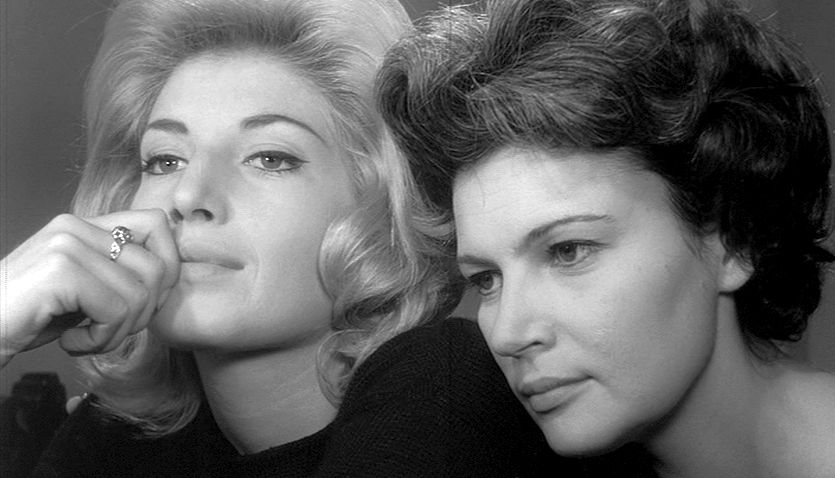
A group of wealthy friends are cruising the sea near Sicily on a yacht. They anchor near an island, swim ashore and begin to explore. Anna (Lea Massari) has quarreled with her lover Sandro (Gabriele Ferzetti), and has been overheard saying she wanted to be left alone. They both go ashore, along with her friend Claudia (Monica Vitti) and others. After a time Anna cannot be found. The others search the island for her; it is mostly rocks and scrubby trees, and there seem few places to hide, but she cannot be found.

The aesthetic marriage of image, performance, and sound (the score is spare, but subtly effective) creates a continuous mood that seems to capture something essential about the human condition. To a certain extent these visual effects go beyond verbal articulation, and Antonioni, himself, has suggested the same thing by shying away from explicit commentary on the film’s meaning. This is evidently what was meant by the Cannes Film Festival Jury Prize’s wording, and also to those who respond to the film’s imagery, when it is said that L’Avventura created “a new movie language”.
Many films are called “classic,” but few qualify as turning points in the evolution of cinematic language, films that opened the way to a more mature art form. Michelangelo Antonioni’s L’Avventura (The Adventure) is such a work. It divided film history into that which came before and that which was possible after its epochal appearance. It expanded our knowledge of what a film could be and do. It is more than a classic, it’s an historical milestone.
(Source:Internet)


Michelangelo Antonioni

Michelangelo Antonioni was born in 1912 into a middle-class family and grew up in bourgeois surroundings of the Italian province. In Bologna he studied economics and commerce while he painted and also wrote criticism for a local newspaper.

In 1939 he went to Rome and worked for the journal "Cinema" studying directorship at the School of Cinema. As he was indebted to neorealism his films reflect his bourgeois roots like in his first movie Cronaca di un amore (1950) or La signora senza camelie (1953) or Le amiche (1955).

His biggest success was the trilogy L'avventura (1960), La notte (1961), and L'eclisse (1962), with which he won several prizes. This success allowed him to go abroad and to work on international scale in English: e.g. Blowup (1966) in London and Zabriskie Point (1970) in the USA as well as Professione: reporter (1975). A stroke in 1985 severely inhibited his productivity until his death in 2007.
(Source:Internet)


Jan 31, 2011

6th Feb 2011; Christian Petzold's YELLA

YELLA
A film by Christian Petzold
Year : 2007
Country : Germany
German with English subtitles
Run time 89 minutes
6th Feb 2011 ; 5.45pm
Perks Mini Theater
Perks School, off Trichy Road
http://konangalfilmsociety.blogspot.com/

Documentary of film maker Christian Petzold’s
interview will follow the main screening


Yella is a reserved young woman with unrevealed depths of intelligence, larceny and passion. Their gradual revelation makes this more than an ordinary thriller, in great part because of the performance of Nina Hoss in the title role.
German writer-director Christian Petzold returns to top form in "Yella," another precision-helmed, tightly wound, metaphysical thriller that confirms him as one of Germany's finest middle-generation directors.
Topped by a mesmerizing performance by Petzold favorite Nina Hoss ("Wolfsburg," "Something to Remind Me") as a young businesswoman unwrapping her inner demons and ambitions.Topped by a mesmerizing performance by Petzold favorite Nina Hoss ("Wolfsburg," "Something to Remind Me") as a young businesswoman unwrapping her inner demons and ambitions.
On screen virtually the whole time, Yella Fichte (Hoss) is first seen arriving by train in her home town of Wittenberge, northwest of Berlin and on the banks of the River Elbe. In the street she's accosted by -- and gives short shrift to -- a guy who turns out to be her ex-husband, Ben (Hinnerk Schoenemann).
Petzold's best pictures have always had an unsettling emotional undercurrent beneath their clean, clinical direction. "Yella," with its painterly interludes in which the rural summertime scenery takes on a threatening edge, is strongly in this line. Main character remains something of an enigma, but Hoss, dressed throughout in a eye-catching red blouse that cuts like an open wound through the black-and-grey business world in which she operates, brings a laser-like focus to the role that holds the attention.

Geography is important in the movie - Yella's journey is essentially from the former East to the former West, from a pretty but still depressed region to a city schooled in capitalist economics, with the River Elbe as a kind of border between the two. Thus, this is also a portrait of an easterner finding her vocation but losing her soul.


Christian Petzold

Christian Petzold was born on 14.9.1960 in Hilden and lives in Berlin since 1981. He studied Germanic and theater studies, and also worked as a film critic. From 1988 – 1994 he studied at the German Film and Television Academy in Berlin and was incidentally served as assistant director Harun Farocki and Hartmut Bitomsky. In 1995 he directed his first feature film, The pilots.
His film The Internal Security (2000) was awarded the German Film Award in Gold. In 2005 took part in Christian Petzold’s Ghosts (2004) competition at the Berlinale. The film met with a very mixed response from the audience. The German Film Critics has named the bulky work, however, during the Berlinale, as the next best movie of 2005. For his TV movie Wolfsburg (awarded 2003) Petzold in March 2005 the Adolf Grimme Prize in Gold.(Source:Internet)

Jan 24, 2011

29th Jan 2011; Documentaries on Art - PICASSO


DOCUMENTARIES ON ART


PICASSO


29th Jan 2011; 5.45pm
Contemplate Art Gallery
2 Floor, Rajshree Ford Bldgs
Avanashi Road
opp. Krishnammal College
http://konangalfilmsociety.blogspot.com/
http://www.contemplate.co.in


“The different styles I have been using in my art must not be seen as an evolution, or as steps towards an unknown ideal of painting. Everything I have ever made was made for the present and with the hope that it would always remain in the present. I have never had time for the idea of searching. Whenever I wanted to express something, I did so without thinking of the past or the future. I have never made radically different experiments. Whenever I wanted to say something, I said it the way I believed I should. Different themes inevitably require different methods of expression. This does not imply either evolution or progress; it is a matter of following the idea one wants to express and the way in which one wants to express it.” – Picasso

Screening of two documentaries:
(1) Guernica (2) Modern Masters – Picasso


Guernica, (1950) – A film by Alain Resnais -13 mins - French with English sub titles.
On April 27, 1937, in the midst of a grueling and increasingly brutal Spanish Civil War, the ancient Basque town of Guernica was subjected to an extended duration bombardment campaign by German forces in an unrelenting aerial campaign designed to demoralize the collective psyche of the Basque nation and to also show camaraderie (and military alliance) with the nationalists under Generalissimo Francisco Franco.

Composed of a series of fractured, compartmentalized images that traces the evolution of the paintings and sculptures of cubist artist Pablo Picasso from 1906 to 1937 (leading to his masterwork Guernica) set against an evocative narrative ode written by French lyrical poet Paul Éluard and recited in an off-screen performance reading by Jacques Pruvost and María Casarès, Guernica is a thoughtful and passionate meditation on barbarism, warfare, and human resilience. Alain Resnais incorporates ingenious, rapid cut editing strategies and fragmented, subset images that not only visually integrate the principles of cubism in cinematic form, but moreover, reinforce the film's overarching, thematic structure of multifacetedness that subtly - but inescapably - reflect on Spain's (then) continued struggle under fascism at the end of World War


II: Modern Masters – Picasso – 59:15 mins – English with English subtitles

The life of Pablo Picasso is an exciting story of rebellion, riches, women and great art. In this episode of a four-part series dedicated to Modern Art, journalist Alastair Sooke travels through France, Spain and the US to see some of the artist’s great works and recount tales from his life story. Talking to architects, fashion experts and artists, he investigates how Picasso’s influence, particularly that of his Cubist work, continues to pervade modern life today, in the shape of buildings, interior design, clothes and of course contemporary art. Tracking down former Picasso model Sylvette David to her current home in Britain, he also hears how Picasso’s images of her inspired the look of screen siren Brigitte Bardot.


PABLO PICASSO

' Everyone wants to understand art. Why don't we try to understand the song of a bird? Why do we love the night, the flowers, everything around us, without trying to understand them? But in the case of a painting, people think they have to understand. If only they would realize above all that an artist works of necessity, that he himself is only an insignificant part of the world, and that no more importance should be attached to him than to plenty of other things which please us in the world though we can’t explain them; people who try to explain pictures are usually barking up the wrong tree.' – Picasso

Picasso, (born October 25, 1881, Málaga, Spain—died April 8, 1973, Mougins, France) Spanish expatriate painter, sculptor, printmaker, ceramicist, and stage designer, one of the greatest and most influential artists of the 20th century and the creator (with Georges Braque) of Cubism.
The enormous body of Picasso's work remains, and the legend lives on—a tribute to the vitality of the “disquieting” Spaniard with the “sombre . . . piercing” eyes who superstitiously believed that work would keep him alive. For nearly 80 of his 91 years Picasso devoted himself to an artistic production that contributed significantly to and paralleled the whole development of modern art in the 20th century.Picasso started to paint when he was eight years old. As Picasso's father was an art teacher, he would take full control of Pablo's education in art.. In 1892 Pablo joined his father at the Instituto da Guarda as a student. For three years Pablo would enjoy a classical art education.In 1895 his father was appointed at the art academy La Lonja in Barcelona, where again he was joined by Pablo. Picasso's father promoted Pablo's independence by renting him a studio in Barcelona.
Before, and shortly after, moving to Paris, Picasso's painting was in its "Blue Period" (1900-1904), which eventually gave way to his "Rose Period" (1905-1906). It wasn't until 1907, though, that Picasso really raised a commotion in the art world. His painting Les Demoiselles d'Avignon marked the beginning of Cubism.

Having caused such a stir, Picasso spent the next fifteen years seeing what, exactly, could be done with Cubism (such as putting paper and bits of string in a painting, thus inventing the collage). The Three Musicians (1921), pretty much summed up Cubism for Picasso.
For the rest of his days, no one style could maintain a hold on Picasso. In fact, he was known to use two or more different styles, side by side, within a single painting. One notable exception is his Surrealistic painting Guernica (1937), arguably one of the greatest pieces of social protest ever created.
Picasso lived long and, indeed, prospered. He grew fabulously wealthy from his phenomenal output (including erotically themed ceramics), took up with younger and younger women, entertained the world with his outspoken remarks, and painted almost right up until he died at the age of 91. In 2003, his relatives inagurated the Museo Picasso Malaga, a museum located in his hometown of Malaga, Spain. The museum is dedicated to him and his lifetime work. (Source:Internet)

Jan 16, 2011

23rd Jan 2011; The Shop On Main Street

The Shop on Main Street
A film by Ján Kadár and Elmar Klos
Year ; 1965
Country : Czechoslovakia
Slovak/ German with English sub titles
Runtime: 128 minutes
23rd Jan 2011; 5.45 pm
Perks Mini Theater

The Shop on Main Street is filled with so many perfectly realized scenes, and so much lovingly observed human interaction, that it reminds us of the kind of honesty the best movies can achieve. The film’s two stars, Josef Kroner and Ida Kaminska, are unexcelled, and form the most charismatically mix-matched star team in memory.
Kroner’s performance is miraculous, economical and tortured as Tono struggles against the coming devastation of his town, his friends, and his soul.
The Shop on Main Street remind us that most movies are emotional frauds, relying on tired tricks to wring feelings from an over stimulated audience. To see this movie is to be in the company of artists who trust their material, and trust the imagination, intelligence, and compassion of their audience.
Racism is looked at deeply and provocatively in this revealing film. During the last World War, a small town in Slovakia was turned into a crucible Fascist state by the Nazis. Locals run everything and there are no Germans in sight. It concerns a not too pretty and mean little man who harbors a resentment against the local Nazis though he does nothing about it.
His own brother-in-law is the town police head and he is given the right to take over the store of an old Jewish woman by his relative when plans for deporting the Jews are well developed. She has lost her husband in the last war and all that is left is this little shop.
When the deportations start she is somehow forgotten and he decides he will do something to hide her. The end has him going through divided outlooks about what to do, both wanting to help her but fearing reprisals.
This is all done with a non-rancorous flair sans any hysterical overtone. This makes it even more poignant. It becomes a statement on how racism can be bred by oversight, plain laziness or general apathy. Directors Jan Kadar and Elmar Klos have built this carefully, and have given a good feel of the times and personalities before the drama erupts.
In contrast to the tragic denouement of the film, The Shop on Main Street closes on a idyllic, dreamlike sequence, showing the smiling shopkeeper and clerk walking together through the countryside, free from all danger and fear.
(Source:Internet)


Ján Kadár and Elmar Klos

Czech director Ján Kadár (1918 - 1979) was of Jewish extraction himself, but claimed he rarely encountered anti - Semitism during his lifetime. He was born on April 1, 1918, in the same year that Czechoslovakia achieved independence in the aftermath of World War I's end and the dissolution of the Austro - Hungarian empire. As a young man, he studied law in the Slovak capital of Bratislava, but abandoned it to pursue photography by 1938.

The Munich Agreement that same year, between Nazi Germany and other western European nations, gave tacit approval for Germany's invasion of Czechoslovakia.

Czechoslovakia's Jews were deported to Nazi concentration camps, and at one point Kadár ran afoul of authorities and spent time in a labor camp himself in the early 1940s. After the war's end, Czechoslovakia became a Communist Party - dominated socialist republic, closely allied with the Soviet Union. Kadár moved into the re - emerging film industry, and became a producer and director at the Bratislava Studio of Short Films.

In 1946 Kadár joined the highly regarded Barrandov Studios in Prague, sometimes called the "Hollywood of the East." There he was a scriptwriter and assistant director, and directed his first feature film, Katka (Cathy), in 1950.

At Barrandov Kadár had met Elmar Klos, and the two began a collaboration in 1952 that would endure for much of their career inside Czechoslovakia. In 1965, signs of a new cultural and political movement in Czechoslovakia were emerging. Certain restrictions had loosened, and the arts began to flourish. Kadár's Obchod na korze (The Shop on Main Street) was released in 1965 and became one of the first products of the Czech New Wave to win international acclaim. Kadár borrowed the story from a novel by Ladislav Grosman called The Trap, and worked with Klos to adapt the novel for the screenplay.

In August of 1968 Soviet tanks rolled across the borders. The brief era known as that year's "Prague Spring" abruptly ended, as did the groundbreaking works from the country's films studios. Kadár left Czechoslovakia, setting first in Vienna and later in Los Angeles. At the time of the Soviet invasion, he and Klos were working on a Czech - American production called Adrift. After some movie ventures in Hollywood, Kadár spent the rest of the decade making mostly television films.

Kadár died on June 1, 1979, in Los Angeles. Elmar Klos passed away on 31st July 1993 in Czechoslovakia.