Jan 4, 2011

9th Jan 2011; Kurosawa's KAKGEMUSHA

KAGEMUSHA
A film by Akira Kurosawa
Year : 1980
Country: Japan
Runtime : 2.39 minutes
Japanese with English subtitles
9th January 2011; 5.45pm
Perks Mini Theater, Perks school

At the age of seventy, Akira Kurosawa made an epic that dares to wonder what meaning the samurai code or any human code really has in the life of an individual man. His film is basically the story of one such man, a common thief who, because of his astonishing resemblance to the warlord Shingen, is chosen as Shingen's double.
When Shingen is mortally wounded in battle, the great Takeda clan secretly replaces him with the double_so their enemies will not learn that Shingen is dead. Thus begins a period of three years during which the kagemusha is treated by everyone, even his son and his mistresses, as if he were the real Shingen. Only his closest advisers know the truth.
But he is not Lord Shingen. And so every scene is undercut with irony. It is important that both friends and enemies believe Shingen is alive; his appearance, or shadow, creates both the respect of his clan and the caution of his enemies. If he is unmasked, he is useless; as Shingen's double, he can send hundreds of men to be killed, and his own guards will willingly sacrifice their lives for him. But as himself, he is worthless.
Kurosawa's film contains epic battle scenes of astonishing beauty and scope. And then there are the intimate scenes in the throne room, the bedroom, the castles, and battlefield camps. The great battle scenes glorify the samurai system. Armies of thousands of men throw themselves heedlessly at death, for the sake of pride.
But the intimate scenes undermine that glorious tradition; as everyone holds their breath, Shingen's double is tested in meetings with his son, his mistresses, and his horse. They know him best of all. If they are not fooled, all of the panoply and battlefield courage is meaningless, because the Takeda clan has lost the leader who is their figurehead; the illusion that he exists creates the clan's reality.
Kurosawa made this film after a decade of personal travail. Although he is often considered the greatest living Japanese director, he was unable to find financial backing in Japan when he first tried to make Kagemusha.
There are great images in this film: Of a breathless courier clattering down countless steps, of men passing in front of a blood-red sunset, of a dying horse on a battlefield.
But Kurosawa's last image of the dying Kagemusha floating in the sea, swept by tidal currents past the fallen standard of the Takeda clan summarizes everything: ideas and men are carried along heedlessly by the currents of time, and historical meaning seems to emerge when both happen to be swept in the same way at the same time.
(Source Roger Ebert - http://rogerebert.suntimes.com)


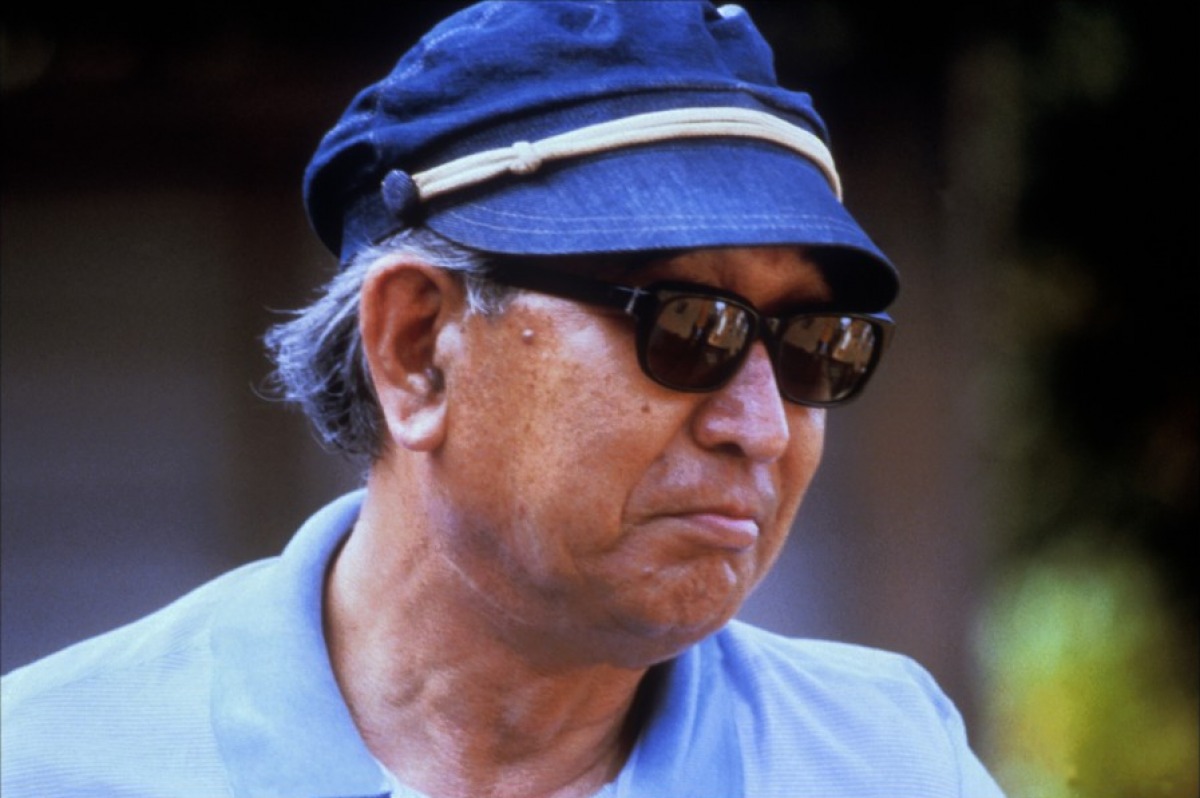


Akira Kurosawa
1910 -1998

Akira Kurosawa was the youngest of seven children, born in Tokyo on 23 March 1910. A talented painter, he enrolled in an art school that emphasized Western styles. Around this time he also joined an artists' group with a great enthusiasm for nineteenth-century Russian literature, with Dostoevsky a particular favourite. Another influence was Heigo, one of his brothers, who loved film and worked as a benshi, a film narrator/commentator for foreign silent films. His suicide deeply affected the director's sensibilities.In 1930 he responded to a newspaper advertisement for assistant directors at a film studio and began assisting Kajiro Yamamoto, who liked the fact he knew 'a lot about things other than movies'. Within five years he was writing scripts and directing whole sequences for Yamamoto films. In 1943 he made his debut as a director with Judo Saga (Sanshiro Sugata), with a magnificent martial-arts sequence.

His early films were produced during the Second World War, so had to comply to themes prescribed by official state propaganda policy. It was Drunken Angel which was Kurosawa's first personally expressive work, made in 1948 and featuring Toshiro Mifune who became Kurosawa's favourite leading man.

For those who discover Kurosawa, they will find a master technician and stylist, with a deep humanism and compassion for his characters and an awe of the enormity of nature. He awakened the West to Japanese cinema with Rashomon, which won the top prize in the Venice Film Festival of 1951, and also a special Oscar for best foreign film. A golden period followed, with the West enthralled by his work. Seven Samurai, Yojimbo etc.

Following Red Beard (Akahige) in 1965 he entered a frustrating period of aborted projects and forced inactivity and when in 1970 his first film in five years (Dodeska-den) failed at the box office, he attempted suicide. Directing a Soviet-Japanese production, Dersu Uzala helped him to recover and took four years to make. It won the Oscar for Best Foreign Film in 1975 and a gold medal at the Moscow Film Festival.

A true auteur, he supervised the editing of nearly all his films and wrote or collaborated on the scripts of most. His memoirs were published in 1982, titled Something like an Autobiography. In 1989 he won an Oscar for Lifetime Achievement. Kurosawa died in 1998.

Dec 21, 2010

26th Dec 2010; Werner Herzog's Fitzcarraldo

Fitzcarraldo
A film by Werner Herzog
Year :1982
Country: Peru
Run time:158 mins
German with English subtitles
26th Dec 2010; 5.45pm
Perks Mini Theater
Perks School
Werner Herzog's "Fitzcarraldo" is one of the great visions of the cinema, and one of the great follies. One would not have been possible without the other. This is a movie about an opera-loving madman who is determined to drag a boat overland from one river system to another. In making the film, Herzog was determined to actually do that, which is more than can be said for Brian Sweeney Fitzgerald, the Irishman whose story inspired him.

"Fitzcarraldo" (1982) is one of those brave and epic films. Herzog could have used special effects for his scenes of the 360-ton boat being hauled up a muddy 40-degree slope in the jungle, but he believed we could tell the difference: "This is not a plastic boat."
Watching the film, watching Fitzcarraldo (Klaus Kinski) raving in the jungle in his white suit and floppy panama hat, watching Indians operating a block-and-tackle system to drag the boat out of the muck, we're struck by the fact that this is actually happening, that this huge boat is inching its way onto land -- as Fitzcarraldo (who got his name because the locals could not pronounce "Fitzgerald") serenades the jungle with his scratchy old Caruso recordings.
Herzog turned to Klaus Kinski, the legendary wild man who had starred in his "Aguirre, the Wrath of God" (1972) and "Nosferatu" (1979). Kinski was a better choice for the role than Robards, for the same reason a real boat was better than a model: Robards would have been playing a madman, but to see Kinski is to be convinced of his ruling angers and demons.

"Fitzcarraldo" opens on the note of madness, which it will sustain. Out of the dark void of the Amazon comes a boat, its motor dead, the shock-haired Kinski furiously rowing at the prow, while his mistress (Claudia Cardinale) watches anxiously behind him. They are late for the opera.

Herzog has always been more fascinated by image than story, and here he sears his images into the film. He worked with indigenous Amazonian Indians, whose faces become one of the important elements of the work.
Among directors of the last four decades, has anyone created a more impassioned and adventurous career than Werner Herzog? Most people have only seen a few of his films, or none; he cannot be fully appreciated without a familiarity with his many documentaries and more obscure features (such as "Heart of Glass" and "Stroszek"). corrupted by the thin gruel of mass media.
Again and again, in films shot in Africa, Australia, Southeast Asia and South America, he has been drawn to the farthest reaches of the earth and to the people who live there with their images uncorrupted by the thin gruel of mass media.
( Source: Roger Ebert - http://rogerebert.suntimes.com)


Werner Herzog

One of the most influential filmmakers in New German Cinema and one of the most extreme personalities in film per se, larger-than-life Werner Herzog quickly gained recognition not only for creating some of the most fantastic narratives in the history of the medium, but for pushing himself and his crew to absurd and unprecedented lengths, again and again, in order to achieve the effects he demanded.

Werner Herzog (Werner Stipetic) was born Sept. 5, 1942 in Munich. He grew up on a farm in the Bavarian mountains. After his parents' divorce, Herzog and his mother moved to Munich where he attended High School (graduated in 1961). He travelled through Jugoslavia and Greece, worked in Manchester and - fact or fiction? - as a rodeo rider. At the age of 16 he converted to catholicism.

In 1974, he walked from Munich to Paris to see the sick Lotte Eisner. He wrote a dairy about his pilgrimage entitled Vom Gehen im Eis (Walking on Ice) for which he received a literary award (Rausirer Literaturpreis) in 1979. He said that when he was 14 years old, he knew that he would be making films. His first short was completed in 1962 (Herakles) and one year later he founded his own production company.

Herzog studied history, literature and drama in Munich and Pittsburgh (Fulbright) but not for very long. He never attended a film school and had no formal film education. 1964 he won the Carl Mayer Prize for the screenplay that was to become his first feature film, Signs of Life (Lebenszeichen), which was financed by the Kuratorium Junger Deutscher Film (300.000DM) and won the Bundesfilmpreis for best first feature.

Among Herzog's most popular films, though not an immediate success, was Aguirre: The Wrath of God (1972) with Klaus Kinski, who also starred in Nosferatu (1979),Woyzeck (1979), Fitzcarraldo (1982), and Cobra Verde (1987). One of his biggest successes was Every Man for Himself and God Against All / The Mystery (Enigma) of Kaspar Hauser (1974), which won the Special Award in Cannes (1975) and several Federal Film Prizes (1975).

Herzog is famous for dealing with marginalized figures and for his choice of 'exotic' sets (Peru, Brazil, Australia). Herzog, the "visionary" of the NGC, insists that "film is not the art of scholars, but of illiterates."

In recent years, Herzog released a number of documentaries and directed various operas. His latest feature film is Invincible. He lives in Munich and Los Angeles.

Nov 14, 2010

20th Nov 2010; Documentaries on Art : DALI

Contemplate Art Gallery
&
Konangal
jointly present

DOCUMENTARIES ON ART
SALVADOR DALI
20th Nov 2010 ; 5.45 pm
Contemplate Art Gallery
2nd floor , Rajshree Ford Bldg.
Opp- PSG Krishnammal College
Avanashi Road

1. Documentary on Salvador Dali

2. " Private Life of a Masterpiece"
documentary on Dali’s great masterpiece

“Christ of Saint John of the Cross"

Salvador Dali is considered as the greatest artist of the surrealist art movement and one of the greatest masters of art of the twentieth century. During his lifetime the public got a picture of an bizarre paranoid. His personality caused a lot of controversy.
Salvador Dali was born as the son of a prestigious notary in the small town of Figueras in Northern Spain. His talent as an artist showed at an early age and Salvador Felipe Jacinto Dali received his first drawing lessons when he was ten years old. Dali began to study art at the Royal Academy of Art in Madrid. In 1928 Dali went to Paris where he met the Spanish painters Pablo Picasso and Joan Miro. He established himself as the principal figure of a group of surrealist artists grouped around Andre Breton,. He also partnered with the great surrealist film maker Luis Bunuel in the making of two films.
By 1929 Dali had found his personal style that should make him famous - the world of the unconscious that is recalled during our dreams. The surrealist theory is based on the theories of the psychologist Dr. Sigmund Freud. Recurring images of burning giraffes and melting watches became the artist's surrealist trademarks. His great craftsmanship allowed him to execute his paintings in a nearly photo-realistic style. No wonder that the artist was a great admirer of the Italian Renaissance painter Raphael.
Meeting Gala was the most important event in the artist's life and decisive for his future career. For him she was everything. Most of all Gala was a stabilizing factor in his life. And she managed his exhibitions in Europe and United States.
To evade World War II, Dali chose the U.S.A. as his permanent residence in 1940. He had a series of spectacular exhibitions, among others a great retrospective at the Museum of Modern Art in New York. His art works became a popular trademark and besides painting he pursued other activities - jewelry and clothing designs for Coco Chanel or film making with Alfred Hitchcock.
In 1948 Dali and Gala returned to Europe. Dali developed a lively interest in science, religion and history. He integrated things into his art that he had picked up from popular science magazines. Another source of inspiration were the great classical masters of painting like Raphael, Velasquez or the French painter Ingres. In 1958 the artist began his series of large sized history paintings. Dali is the only known artist who had two museums dedicated exclusively to his works at lifetime.

Towards the end of his life, Dali lived in the tower of his own museum where he died on January 23, 1989 from heart failure.


Nov 8, 2010

14th Nov 2010; Robert Bresson's A Man Escaped

A Man Escaped
A film by Robert Bresson
Year:1956
Country : France
Runtime : 99 min
French with English subtitles
14th Nov 2010;5.45pm
Perks Mini Theater
Perks School
http://konangalfilmsociety.blogspot.com/

Bresson’s finest film, ranks as one of the great artistic
achievements in cinema. With this work, alone,
Bresson assured himself a place in the Pantheon.

- Film Sufi

A Man Escaped succeeds simply as the most tingly, tension-filled prison escape caper you'll ever see, but given that the prison in question is Nazi sadist Klaus Barbie's holding pen for condemned French resistance fighters, the story, which is based on true events, becomes a good vs. evil parable for the ages.

A Man Escaped opens with the indelible image of a pair of restless hands belonging to a French resistance officer named Lieutenant Fontaine (Francois Leterrier). His face is inscrutable and impassive, concealing his calculated attempt to flee from the escorted prison transport vehicle. Fontaine (François Leterrier) is just as single-minded in his purpose. In the prison he examines the grounds, taps messages to people in the next cell, and takes inventory of the raw materials in his cell.
In marked contrast to another famous French parable of inner and outward bondage and freedom — “The Myth of Sisyphus” by Bresson’s contemporary and friend, existentialist philospher Albert Camus — A Man Escaped is not content simply with the struggle toward the goal in itself. Fontaine must really escape, not merely make the attempt. Yet so objective and unsparing is Bresson’s direction that how the story actually ends remains uncertain until the very last shot. With his final frame, Bresson completes his sublime rebuttal of Camus’ contention that “the struggle itself” is enough to “fill a man’s heart,” even if the quest is futile.

A Man Escaped offers newcomers to Bresson perhaps the most accessible point of entry into the work of this brilliant, challenging, artist. It’s also the film in which Bresson’s mature style fully crystallized, and provided the filmmaker with perhaps the ideal subject for his singular stylistic preferences.
Robert Bresson's spare imagery and poetic realism depict the harsh existence of the prison camp without emotional manipulation or overt symbolism. The objective distance of retrospective narration divorces the precise and factual revelation of the story from the bias of perspective associated with the tension of his singular objective.


Among Bresson’s hallmarks is the juxtaposition of onscreen images with sounds from unseen, off-screen sources — a device that seems uniquely suited to the world of a narrow prison cell, where Fontaine has both a limited range of vision, and ample reason to attend to every boot scrape and unknown creak. And Bresson’s insistence on eliciting bare performances stripped of all emotion from novice actors may better suit a prisoner reduced to a singular purpose, his will wholly bent to his course of action, than any other protagonist in his body of work.


Robert Bresson

Robert Bresson’s 13 features over 40 years constitute arguably the most original and brilliant body of work over a long career from a film director in the history of cinema. He is the most idiosyncratic and uncompromising of all major filmmakers, in the sense that he always tried to create precisely what he wanted without surrendering to considerations of commerce, audience popularity, or people’s preconceptions of what cinema should be. And although it might be argued that his venture into colour from Une Femme douce (1969) onwards was probably against his better judgement, he shows mastery in its use.

Born in central France and educated in Paris, Bresson’s early ambition was to be a painter. He ventured into filmmaking with the short Les Affaires publiques (1934), a satire with nods to Clair and Vigo, which was rediscovered in the 1980s after being thought lost. After a year or so as a prisoner-of-war he was approached by a Paris priest with a proposal for a film about the Bethany order of nuns, which became Les Anges du péché (1943). His next feature was also made during the Occupation, and filmmaking had by then definitely supplanted painting. The confusion over his date of birth, symbolic perhaps of his reclusive nature, caused reviewers of his final filmL’Argent (1983) to marvel over how a man "in his late 70s" or alternatively "in his 80s" could show such youthful exuberance in his filmmaking.

Three formative influences in Bresson’s life undoubtedly mark his films: his Catholicism, which took the form of the predestinarian French strain known as Jansenism; his early years as a painter; and his experiences as a prisoner-of-war. These influences manifest themselves respectively in the recurrent themes of free-will versus determinism, in the extreme and austere precision with which he composes a shot, and in the frequent use of the prison motif (two films are located almost entirely inside prisons).

All Bresson’s features after the first have literary antecedents of one form or another, albeit updated. Two are from Dostoevsky (Une Femme douceand Quatre nuits), two from Bernanos (Journal and Mouchette), one from Tolstoy (L’Argent), one from Diderot (Les Dames), while Un Condamné and Le Procès are based on the written accounts of the true events. In addition Pickpocket is clearly influenced by Dostoevsky’s Crime and Punishment and Balthazar has a similar premiss to the same author’s The Idiot. Lancelot du Lac is derived from Malory’s Arthurian legends, while Le Diable probablement (1977) was inspired by a newspaper report, as is stated at the start of the film.

A critic once wrote that Mizoguchi’s Sansho Dayu (1954) "is one of those films for whose sake the cinema exists". For many of us, the same can be said of the work of Robert Bresson.

(Source : Roger Ebert , Senses Of Cinema , Ozu's World Movie Reviews )


Nov 2, 2010

Art Documentary Screening 30th Oct 2010

Art Documentary screening at
Contemplate Art Gallery
on 30th October 2010